

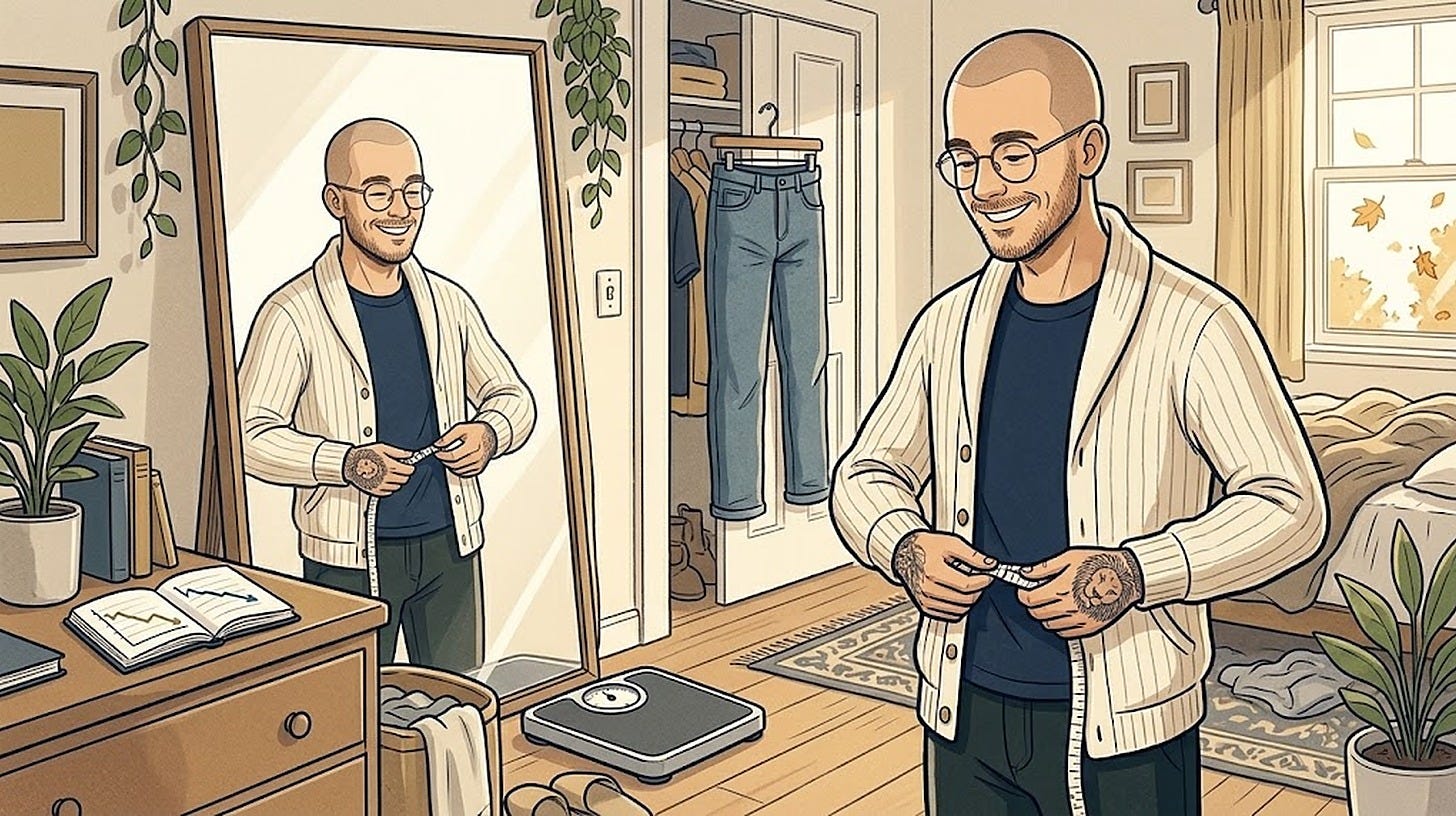
The short answer: after 50, the number on the scale only tells you how heavy you are, not what you're made of. The three measurements that matter more are your body fat percentage, your body measurements (especially your waist), and how your clothes fit. Before and after photos are a great fourth. If you're strength training, you can lose fat and gain muscle at the same time, and the scale may barely move while your body changes a lot.
You've been doing everything right for three weeks. Strength training, walking, eating well, hitting your protein. You step on the scale Monday morning and it hasn't moved. Or worse, it's up a pound. And the thought comes fast: "This isn't working."
I hear that every week. After working with over 1,300 people, most of them over 50, I can tell you the scale is usually the least useful number you can look at. In Episode 463 of the Forever Fit Podcast, I walked through the three numbers I'd track instead. Here they are, with the full episode at the bottom.
Why doesn't the scale tell the whole story after 50?
The scale tells you one thing: how heavy you are. It can't tell you whether you lost fat, lost muscle or just lost water.
That matters a lot after 50. We start losing muscle as early as our 30s, and after 50 it speeds up. That natural loss of muscle is called sarcopenia. If you lose muscle, you'll be lighter on the scale, but you won't look or feel fitter. You'll often end up what people call "skinny fat": thin in clothes, but soft, with less strength.
Muscle is also much more compact than fat. In the episode I held up a model of five pounds of fat. Five pounds of muscle weighs exactly the same but takes up roughly a quarter to half the space. So when you build muscle and lose fat at the same time, the scale can barely move while your body visibly changes.
And in all my years of coaching, nobody has ever told me, "I want to look skinny and flabby." When we dig deeper, people want less fat and more muscle. The scale can't measure either.
Why does the scale jump overnight?
Your weight swings from day to day for reasons that have nothing to do with fat: a salty dinner, eating later than usual, more carbohydrates (which store water in your muscles), alcohol, or simply having more food in your body.
You can't gain a pound of fat overnight. A pound of fat holds roughly 3,500 calories of energy. If your maintenance is 2,000 calories a day, you'd need to eat about 5,500 calories in one day to theoretically add one pound of fat. And if you did eat that much, the scale would probably jump four or five pounds the next morning anyway, almost all of it water, food and stored carbohydrate.
So when the scale is up a pound, don't panic. It's not fat.
Number 1: What's the best way to track body fat?
Body fat percentage is the number that actually reflects what you're trying to change. Here are three ways to measure it, from most to least precise.
A DEXA scan. This is a medical scan that shows how much fat and lean muscle you have, broken down by arms, legs and trunk. Some also show bone density. It's the most precise option and also the most costly, so once every three to six months is plenty.
A smart scale. This is my personal method. You step on it at home and it estimates your body fat. It isn't as precise as a DEXA, but it's what I call "accurately inaccurate": if you measure the same way every time, the trend is reliable. If it says 25% when you start and 22% a few months later, you've lost about 3%, even if the real starting number was 24 or 26. Weigh yourself first thing in the morning, after using the bathroom and before drinking anything. If your scale has an "athlete mode," read the description carefully and choose the right setting, because it changes the calculation a lot.
Calipers. The cheapest option. You pinch the skin and fat at a few spots, measure the thickness and use a formula. It takes more practice and you need to pinch the same spots every time, so it's the least consistent.
Here's why body fat beats weight. If you keep the same amount of fat and build muscle, your body fat percentage goes down, because fat is now a smaller share of your total body. Lose fat while you build muscle and it drops even faster. That's what body recomposition is.
Number 2: Which body measurements should you take?
Grab a soft measuring tape (the self-locking kind makes it easy to do on your own) and measure your shoulders, chest, waist, hips, each thigh and each arm.
As you strength train, some areas may grow a little, like your back, chest and legs, because you're building muscle. Meanwhile your waist usually shrinks as you lose fat. That's why people say, "I've only lost two pounds, but three inches are gone from my waist."
In my own last transformation, the scale changed by about 10 pounds, but I looked like I'd lost 20, because I'd built muscle and lost fat at the same time.
Measure every two to four weeks. Measurements change more slowly than the scale, so checking more often just adds frustration.
Number 3: Why do your clothes fit differently before the scale moves?
This is the one our members notice first. In the success story interviews on the podcast, people talk about their clothes fitting differently long before the scale reached the number they had in their heads.
One member I interviewed recently lost 20 pounds on the scale. But looking at his data and photos, he'd also built about 10 pounds of muscle. That means he lost around 30 pounds of fat, and his waist went from about a 39 or 40 down to a 34. That's a completely different wardrobe. For many of the women we work with, it shows up first in pants, dresses and blouses.
Your clothes don't care what the scale says. They respond to your shape.
Bonus: Should you take before and after photos?
Yes, even though almost nobody wants to. Take a front, side and back photo when you start, and keep them private. You don't have to show anyone.
You see yourself in the mirror every day, so changes are hard to notice. On a week when the scale is flat and your measurements barely moved, put your current photos next to your first ones. Almost every member I've worked with is grateful they took them. It's the moment they realize how far they've come.
Why can't you rush your results after 50?
When people get frustrated with the scale, they often cut calories hard, add lots of cardio and skip strength training. After 50, that's exactly the environment where your body burns through muscle and holds on to fat. You end up lighter and softer.
That's why I recommend a small calorie deficit (we usually start around 200 to 300 calories a day, not 500 to 1,000), strength training at least three times a week, and enough protein. Your body decides how fast it responds. Your job is to create the right environment and stay consistent long enough for it to adapt.
The scale is one pixel of a whole picture. One brushstroke of a painting. Don't let one pixel decide how you feel about the whole thing.
Key takeaways
1. The scale only measures weight, not fat or muscle, and daily jumps are almost always water and food.
2. Track body fat percentage with a DEXA, a smart scale or calipers. Consistency matters more than precision.
3. Measure your waist, hips, chest, arms and thighs every two to four weeks.
4. Notice how your clothes fit. It often changes before the scale does.
5. Take private before photos. You'll be glad you did.
Listen to the full conversation
Timestamps
00:00 Why the number on the scale isn't the whole story
03:13 Number 1: Body fat percentage (DEXA, smart scale, calipers)
08:52 Number 2: Body measurements
10:48 Number 3: How your clothes fit
12:20 Why the scale is just one pixel of the picture
13:01 Why steep diets backfire after 50
16:02 Bonus: Before and after photos
This week I also wrote about the strength training sweet spot from a 30-year study: about two hours a week. Strength training is what makes these three numbers move in the right direction, and tomorrow paid members get The 2-Hour Week, the full plan with a printable log.
If you'd like help with your own body recomposition, Ivy and I teach a free masterclass on Saturday, November 14 at 9 AM Pacific. Register at mavywellness.com/live.
Sincerely,
Maxime Sigouin
Co-founder of Mavy Wellness
Author of Forever Fit
Get your copy here, free worldwide shipping
Maxime Sigouin is the co-founder of Mavy Wellness, author of the #1 bestseller Forever Fit and host of the Forever Fit Podcast. He and his team have coached over 1,300 adults, most of them over 50, to build muscle and lose fat on a whole food plant-based lifestyle.