

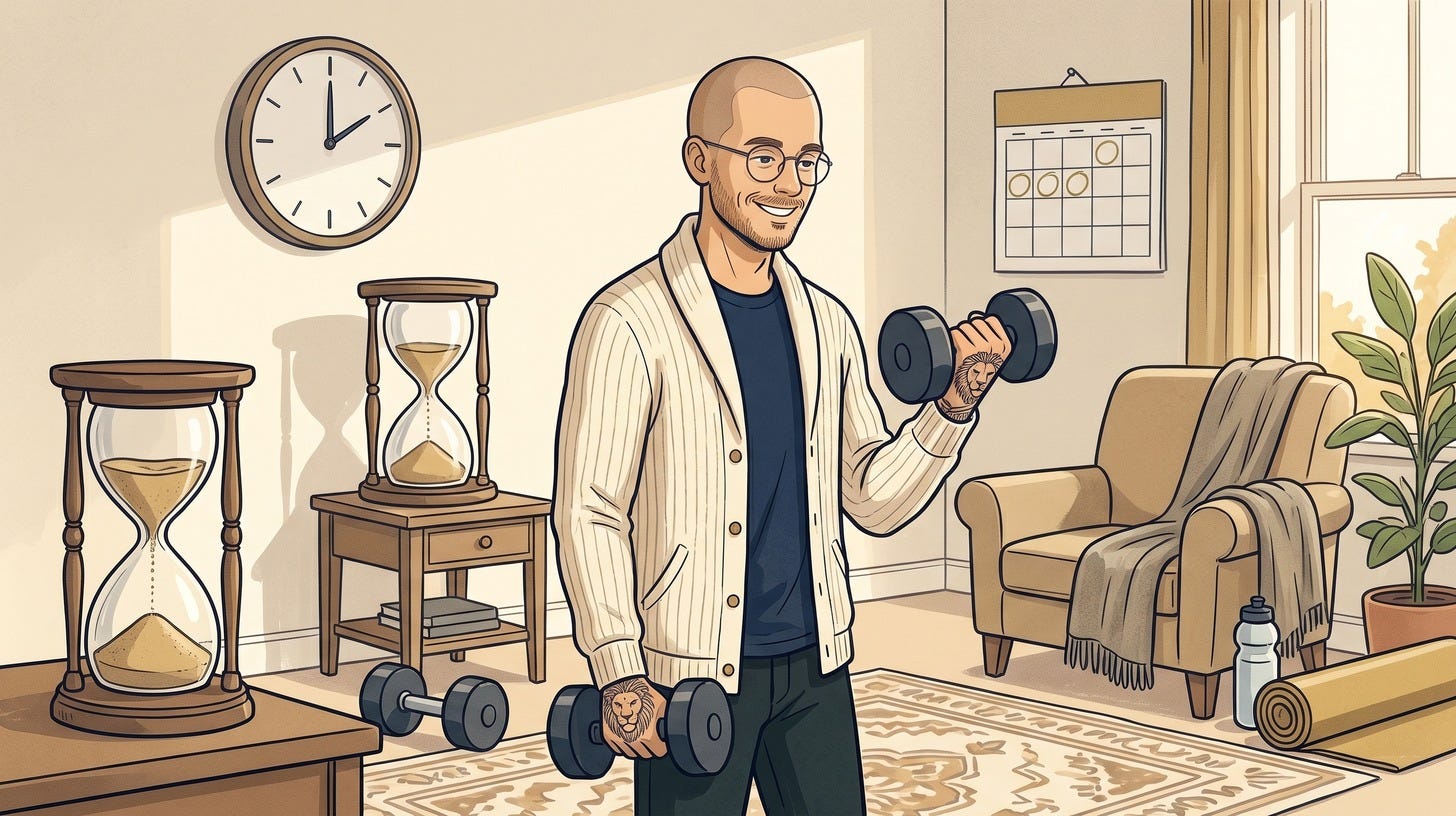
It's Sunday evening and you're on the couch, scrolling. A video pops up of someone in a gym at 5 AM, two hours into a workout, dripping sweat. You put the phone down and feel that little sinking feeling. You tell yourself the same thing so many people over 50 tell me: "If that's what it takes to stay strong, I can't do it. I don't have that kind of time."
I understand why you'd think that. Fitness online is full of extremes. Two hour sessions, six days a week, early alarms. If that's the picture in your head, staying home on the couch almost feels reasonable.
But a large study published this year points to a very different number. The amount of strength training linked to the biggest benefit was about two hours a week. Not a day. A week. And going past that didn't add anything. Let me walk you through what the researchers found, and what two hours a week actually looks like.
A Swiss Doctor Figured This Out 500 Years Ago
In the 1500s, a Swiss physician named Paracelsus became known for an idea that still sits at the heart of medicine today. It's usually summed up in one line: the dose makes the poison.
His point was simple. Almost anything can help you or hurt you depending on how much you take. Water keeps you alive, and too much of it at once can be dangerous. A medicine that helps at one dose can do harm at ten times that dose. And too little of something good does almost nothing at all.
So the real question is never just "is this good for me?" It's "how much, and how often?"
Strength training has a dose too. For years, most of us have been guessing at it. Some people do nothing because the "right" amount sounds impossible. Others do far too much, get hurt, and quit. This new research gives us something better than a guess.
About Two Hours a Week Was the Sweet Spot
The study, published in the British Journal of Sports Medicine and led by researchers at Harvard, pulled together three long-running studies in the United States. Together they followed nearly 150,000 nurses and other health professionals for up to 30 years.
Every couple of years, participants reported how much time they spent on strength training and on aerobic activity like walking, cycling and swimming. Over those three decades, almost 36,000 of them died, which let the researchers see how strength training related to the risk of dying early.
The pattern was clear. People who did about 90 to 120 minutes of strength training a week had about a 13% lower risk of dying from any cause compared with people who did none.
Ninety minutes a week is three sessions of 30 minutes. That's the whole dose. It's a lot closer to what fits into a real life than the gym videos would have you believe.
The Biggest Drops Were in Heart and Brain Deaths
The link was even stronger for two of the biggest causes of death as we age. People in that 90 to 120 minute range had about a 19% lower risk of dying from cardiovascular disease, which includes heart disease and stroke.
And they had about a 27% lower risk of dying from neurological conditions, mainly dementia.
I want to be careful here, because this is the kind of number that gets turned into big promises online. This was an observational study. It shows a link between strength training and a lower risk of dying, not proof that lifting weights caused it. People who lift may also sleep better, walk more or eat differently. The researchers know that, and so should we.
But when nearly 150,000 people are followed for 30 years and the same pattern keeps showing up, it's worth paying attention. Especially for anyone over 50 who wants to stay sharp, independent and present for the people they love.
More Than Two Hours Didn't Help
Here's the part I find most freeing. Beyond about two hours of strength training a week, the risk didn't keep dropping. More wasn't better.
That's Paracelsus all over again. The benefit comes from the right dose, not the biggest one.
I've coached almost 1,300 people, most of them over 50, and I see this all the time. Someone gets motivated, goes from nothing to six days a week, and three weeks later their knees hurt and they've stopped completely. Their body never had a chance to adapt. Two hours a week, done consistently, beats ten hours a week for a month and then nothing.
Lifting and Walking Together Beat Either One Alone
The study also looked at aerobic activity, things like walking, cycling and swimming. On its own, doing at least the recommended amount (around 150 minutes a week of moderate activity) was linked to a 26% to 43% lower risk of death.
But the people with the lowest risk of all did both. Plenty of aerobic activity plus one to two hours of strength training a week was linked to about a 45% lower risk of dying early.
So this isn't strength training versus walking. Most of the people I work with already walk, and that's wonderful. Strength training is the missing piece that makes the walking count even more. They work best as a team.
Your Strength Is a Number Worth Watching
Another study this year, published in JAMA Network Open and led by the University at Buffalo, looked at more than 5,000 women between 63 and 99 years old.
Women with stronger grip strength had a lower risk of dying over the next eight years. On average, every 7 kilograms of extra grip strength went with a 12% lower risk. Women who could stand up from a chair five times faster also had a lower risk.
What stood out to me is that the link held even for women who weren't meeting the usual aerobic exercise guidelines. In other words, strength mattered on its own.
As the lead researcher put it, when we can no longer get out of a chair and move around, we're in trouble. That's exactly what I hear from people every week: "I get up from the floor like a toddler." "Two flights of stairs and my legs are done." Those aren't small things. They're the early signs that strength is slipping, and they're signs we can work on.
None of This Means You're Behind
If you haven't been strength training, that isn't a character flaw. For years, the message has been that real results take hours you don't have. So you did the reasonable thing with an unreasonable picture: you didn't start. You weren't lazy. You were given the wrong dose.
What Two Hours a Week Actually Looks Like
Here's how I'd set it up for most people over 50.
Three sessions of 30 to 40 minutes. Monday, Wednesday and Friday works well, but any three days with a rest day between them is fine. If four shorter sessions fits your life better, do that.
Train your whole body each time. Pick a few big movements that cover most of your muscles at once: something where you sit and stand (a squat or sit-to-stand from a chair), something you push (a wall or counter pushup, or a press), something you pull (a row), and something where you hinge at the hips. Add a carry, like walking with a bag of groceries in each hand.
Make the sets count. A set should end when you could only do one or two more good reps. Easy sets that you could repeat all day don't send your body much of a signal.
Add a little over time. One more rep, or a slightly heavier weight, every week or two. Small jumps, not big ones.
Keep walking. Strength plus walking was the winning combination in the study. Aim for most days of the week.
And if two hours sounds like a lot right now, start smaller. In a Penn State trial published this year, 97 adults with an average age of 74 did just four minutes a day: four exercises for 30 seconds each. After 12 weeks, they could do about four more chair stands in 30 seconds, and they could stand on one leg longer. Four minutes is a real starting point.
On Friday, paid members get the full plan: The 2-Hour Week, with the exact exercises, how to know how hard to push, how to pair it with walking, and a printable weekly log.
What Doesn't Work
Waiting until you have an hour a day. That day usually doesn't come. Thirty minutes, three times a week, is the dose that showed up in the research. Start there.
Doing more because more must be better. Past two hours a week, the study saw no extra benefit. Going from zero to every day is the fastest way I know to get hurt and quit. Slow is smooth, and smooth is fast.
Only walking. Walking is great for your heart, your mood and your steps. But muscle needs resistance to grow, and the lowest risk in the study came from doing both. If walking is all you do right now, strength training is your next step, not a replacement.
Count Your Minutes This Week
Here's your one step for today. Grab a piece of paper and write down how many minutes of strength training you did in the last seven days. Be honest. Zero is a perfectly good number to start from.
Then try this: sit in a sturdy chair, cross your arms over your chest, and time how long it takes you to stand up and sit down five times. Write that number down too. That's your starting point, and it's one of the same tests researchers use.
Paracelsus would tell you the goal isn't to do the most. It's to find the right dose and take it consistently. For strength training, the research says that dose is about two hours a week. Consistency compounds.
If you're over 50 and want help building a strength routine that fits your life, I teach a free masterclass every two weeks. Come join us at mavywellness.com/live.
Sincerely,
Maxime Sigouin
Co-founder of Mavy Wellness
Author of Forever Fit
Get your copy here, free worldwide shipping
References
1. Harvard-led analysis of three US cohort studies (nearly 150,000 adults, up to 30 years), British Journal of Sports Medicine, 2026. Summary: "Scientists find the strength training sweet spot for a longer life," ScienceDaily / The Conversation, August 9, 2026. https://www.sciencedaily.com/releases/2026/08/260808234959.htm
2. LaMonte M. et al. Muscle strength and mortality in women aged 63 to 99, JAMA Network Open, February 13, 2026. Summary: University at Buffalo, February 23, 2026. https://www.buffalo.edu/ubnow/stories/2026/02/muscle-strength-longevity.html
3. Sciamanna C. et al. FAST-2: brief daily functional strength training in adults 65 and older, PLOS One, 2026. Summary: Penn State Health News, June 2026. https://pennstatehealthnews.org/2026/06/four-minutes-of-daily-resistance-training-can-quadruple-fitness-in-older-adults/