Good morning and happy Saturday morning :)
I hope you had a fantastic week, I know I did. I just came back from my seven day monthly digital detox and it was very much needed. I’ll share more about my findings on Wednesdays soul post that I will sent out ❤️
A little house cleaning before we get started,
You will notice that we have a new weekly newsletter structure where I answer your questions that you’ve asked in last week’s edition I sent out.
If you want your questions answered in next week’s segment, reply to this email with your question or comment below on substack.
I decided to switch up the structure so that I can best support you with whatever you may actually need right now in your transformation versus me writing about what I think you may need. I’m willing to film some videos demonstrating exercises, to answer your questions, film a video answering your question or writing out my answer if I think it’s more appropriate, etc...
As the saying goes, you snooze you lose, so don’t be shy and ask your questions away. The more the better ❤️
This week we received three questions, let’s get into them:
Question 1:

Fantastic question Alexandra,
This is one of my favorite technical questions because the answer explains so much of the frustration people feel on the scale.
Here is what is actually happening in your body after a bigger meal or a heavier day of eating.
The first 24 to 48 hours: mostly water, not fat. When you eat more food, especially more carbohydrates and more sodium, your body holds onto extra water. Carbohydrate is stored in your muscles and liver as glycogen, and every gram of glycogen is stored with about three grams of water attached to it. So a bigger carb intake means more glycogen, and more glycogen means more water weight. On top of that, the food itself has not fully moved through your digestive tract yet, so there is simply more physical weightt in your body. None of that is fat. That is the bloat you are feeling.
Days two through five: this is where your nutritionist’s comment comes in. She is right. The number on the scale this week is heavily influenced by what you ate last week, because your body is still catching up on water balance, digestion, and hormonal shifts like cortisol and insulin from the days before. This is why we always tell our clients to judge progress by the week and not by the day.
Actual fat storage: it takes a real, sustained calorie surplus over time. Your body does not efficiently convert a single overeating episode into stored body fat. The process of turning excess carbohydrate into fat, called de novo lipogenesis, is metabolically expensive and your body avoids it unless glycogen stores are already completely full, which is rare for most people.
What actually drives fat gain is a sustained caloric surplus across days and weeks, not one meal or even one day. One indulgent dinner will not make you fatter tomorrow. A pattern of consistent surplus over two, three, four weeks will.
If you think of it this way, one pound of fat is equivalent to 3,500 calories. You would have to be over your maintenance calorie by 3,500 calories to theoretically put on one pound of fat. If you were to eat that much over your surplus, the number on the scale would shoot up even more because of the glycogen, because of the salt, because of having physically more weight in your body.
So if you overate once, the honest response is to simply return win the next meal and revert back to your normal way of eating. No punishing yourself, no extra cardio, no skipping meals. Just get back to your baseline and the water weight will resolve itself within a few days. What matters far more than any single meal is what your average week looks like over a month.
I hope this helps :)
Question 2:
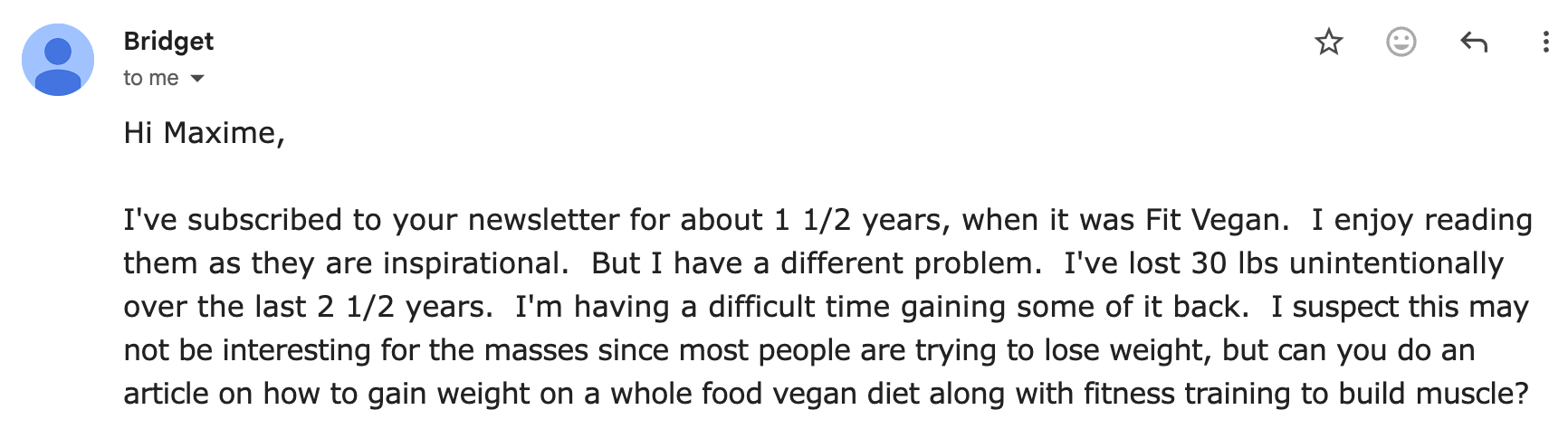
Here is my answer 👇
Here is the article on Reps range, sets and rest period I was referring too:
The Only Rep Ranges, Sets, and Rest Periods You Need to Know After 50

I’m going to nerd out with you today, and I think you’re going to love it.
Question 3:
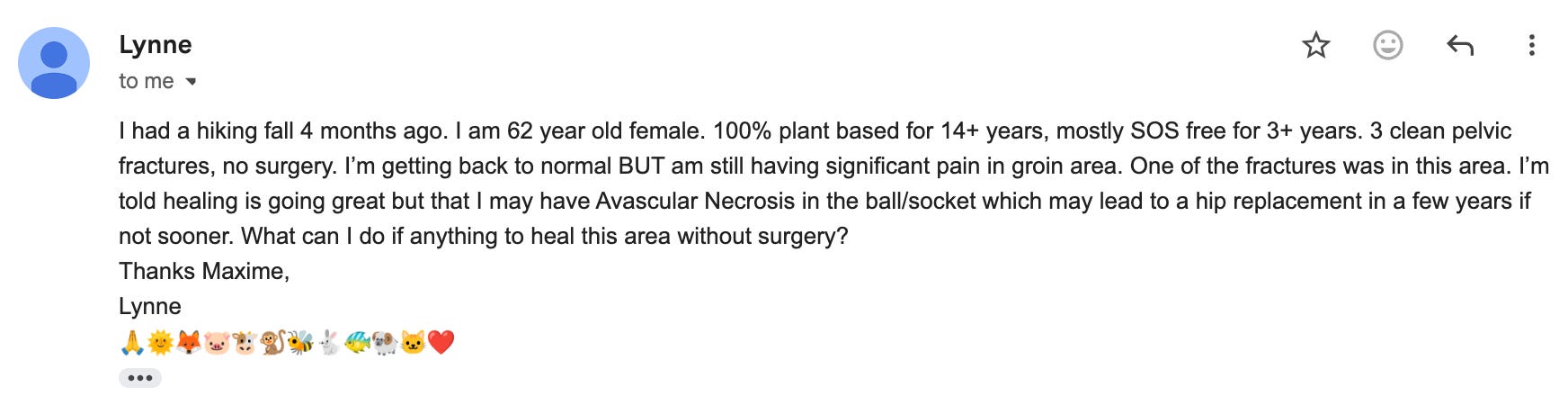
Hi Lynne,
First, thank you for sharing something this personal with me, and I am so sorry you are going through this. Fourteen plus years fully plant based, mostly SOS free for three of those years, and still facing something like this after a fall is genuinely hard, and I want to honor that before anything else.
I have to be honest with you though, because I care more about you actually healing well than I do about sounding like I have all the answers. Avascular necrosis in the hip is a serious thing, and it really does need to stay in the hands of your orthopedic team. Depending on how much of the joint is affected, the path forward could look really different from person to person, sometimes it’s close monitoring, sometimes there are procedures that can help preserve the joint before things progress further, and sometimes surgery ends up being the right call down the road.
I wouldn’t feel right telling you diet is going to reverse something like this on its own, that wouldn’t be fair to you. If you haven’t already, I’d really encourage you to talk to a hip preservation specialist if you can find one near you, since that’s their whole focus and they see cases exactly like yours all the time.
What I can do is share how I’d support your body nutritionally while you’re going through this, alongside whatever your doctors have you doing, not instead of it.
I’d lean into foods that calm inflammation, things like berries, leafy greens, turmeric, ground flax, walnuts. And honestly, since you’ve been plant based a long time, I’d want you to get your vitamin D, B12, and K2 checked if you haven’t recently, those three work together with calcium for bone health and they’re easy to overlook even when you’re eating really well. Good calcium sources for you would be fortified plant milks, tofu made with calcium sulfate, tahini, and greens like collards and bok choy. Ground flax and chia are great for omega-3s too, which matter for circulation, and that feels especially relevant given what you’re dealing with. And I’d just make sure you’re getting enough protein every day since your body leans on that heavily right now to repair itself, things like lentils, tempeh, and tofu are great for that.
But Lynne, please bring all of this to your medical team and let them weigh in, especially before changing anything major. You clearly already have the discipline and consistency that got you this far, I just want that same care applied to the medical side of this too.
I’m genuinely rooting for you and your healing. Please keep me posted on how you’re doing.
Alright that is it for this week’s newsletter. I hope it was helpful :)
Please let me know how you enjoy this format and ask your questions away so that I can best support you.
I hope you have a fantastic weekend and stay tuned for this upcoming Wednesday’s soul post.
Sincerely,
Maxime Sigouin
Ready to take the next step?
📖 Start your transformation for $20 → [Get the book on Amazon]
🎓 Build your body the right way → [Show me the Forever Fit Course] *Coming soon
💪 Get one-on-one coaching from our Forever Fit team → [Book your free call]
🏋️♀️ Join our Las Vegas Fitness workshop in September 2026 → [Get more info]