I’d like to share something personal with you.
Since I was younger, I’ve had this massive, burning desire in my heart to help and serve people.
That feeling has only grown stronger the older I get and the more obstacles I go through in my own life.
It’s a fire in my belly that I can’t tame. It’s so strong that my brain is always thinking of how I can serve. When I read something, my first thought isn’t, “Wow, let me do this,” but rather, “Wow, how can I understand this deeper so that I can teach it and help others with it?”
That is how my brain is wired and why I love to use analogies to explain concepts, because I think it simplifies them and compares them to other areas of life that make it easier to understand the point that I am trying to make.
Because most of life is just about learning to make better decisions with the situation that is presented in front of us. All situations come to us as neutral.
We are the ones that give them meaning; we decide if it’s good or bad. We react or respond to it in a way that is good or bad according to us.
All that to say that my brain is always thinking of how I can conceptualize the actions that I have taken that have been successful and that have allowed me to progress in life and become a better version of myself, all while along the way hitting cool goals that I’ve set for myself.
And recently, I was talking to a close friend about this, and he told me that it was impressive how I could just set a goal and do it. For example, my latest goal was my own personal body recomposition journey, where I managed to hit my goal of dropping from 14% body fat to 10% in 19 weeks.
He got me thinking about how I approach setting a goal and how I work towards it, and so I wanted to share that framework with you:
First, you need to understand that I don’t set goals that I don’t care about or that come from other people (friends, family, society, etc.), because if I don’t really want it, I will 100% not do the necessary actions to get the thing.
All goals, whether fat loss, muscle building, health improvement, business, a better marriage, etc., require a certain level of action-taking and “sacrifice” (for example, not eating a full bag of chips at night that would put you over your calorie goals for the day).
And if one is not ready to do the required level of action, time commitment, and sacrifice, then one shall not get the goal. It’s that simple.
If I want to be fit and lean, but I don’t want to work out, eat healthier, or track my food, I will not be able to get the goal that I want.
If I want a better marriage, but I’m not ready to prioritize time with my partner, work on myself, and ensure that we have open communication, then I will not have a better marriage.
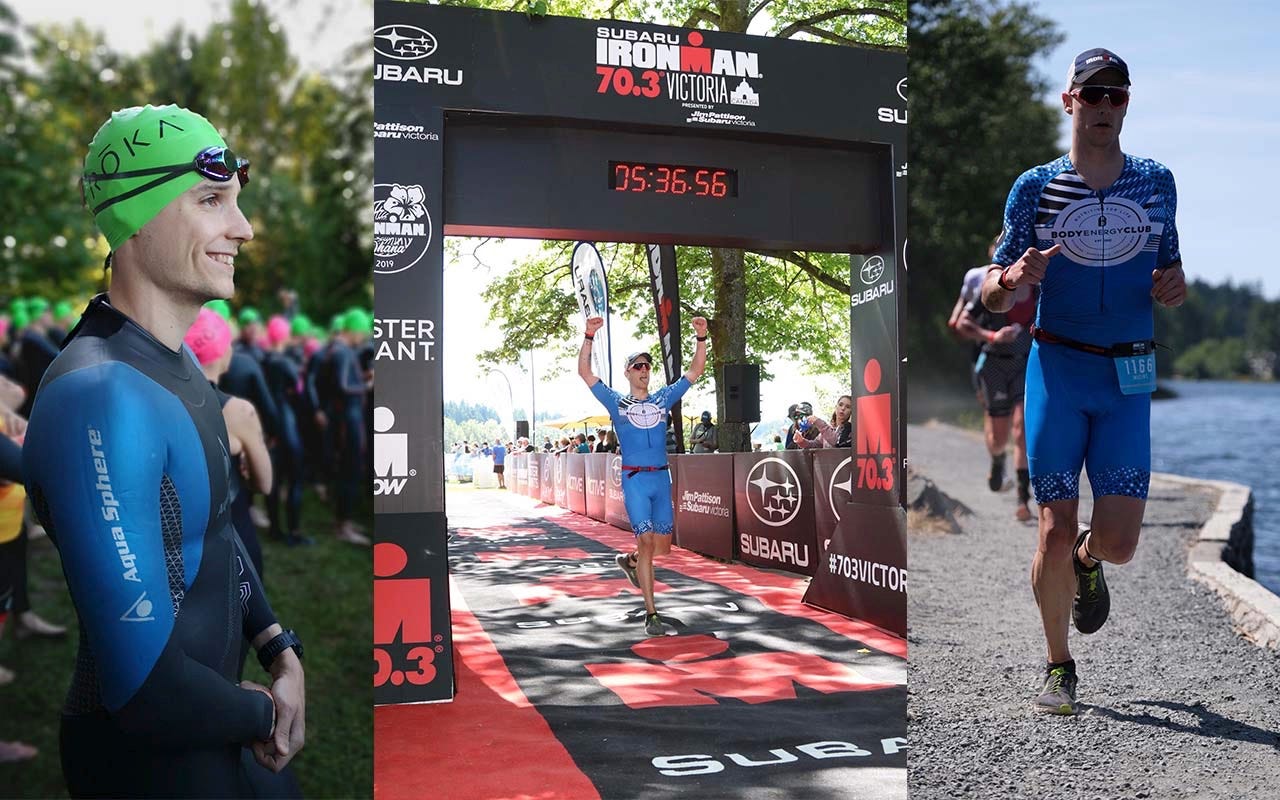
For example, three years ago I told myself that I wanted to get back into Ironman 70.3 racing, because the last time I raced I was in the top 10% in the world for my age group and I wanted to get back into that position, or so I thought.
When I started training for triathlon many years ago, it was when I was going through the hardest time of my life with my late partner and her breast cancer battle.
Triathlon racing saved me; that was my drug. I didn’t drink or do drugs, but I sure as heck numbed myself on the bike for 4-hour rides, 2-hour long runs, and laps and laps in the pool. That was my escape.
But three years ago, my life was good; I had grieved, and I was doing it for fun.
I bought the road bike, bike trainer, signed up for Zwift, got new running shoes, swimming goggles, etc.
I lasted about 5 weeks of training twice a day... because the more I trained, the more it reminded me of what was needed to get to race day and perform.
And honestly, I was not ready to do what was required to reach that goal.
I wasn’t traumatized enough to train that much; that was the reality of it.
And I’m not saying every triathlete is like that; this was just my own personal experience, haha, of how I got into the sport and why I did it.
I couldn’t get it out of my mind to train that much for “no reason,” and it was for no reason because I didn’t care enough for the goal to do the actions necessary to reach my goal.
So I quit the goal. I decided to stop training for triathlon and went back to regular strength training. I went from 15 hours of training a week down to 5 hours, and I was happier.
Maybe one day I’ll race again, but not at this moment in time.
Now fast-forward to many goals later. I set this last goal of improving my body composition, and before I committed to it, I checked in with myself as to whether or not I was willing to do all the actions necessary to get there:
Strength training consistently, which I was already doing
Adding more cardio as the weeks progressed in order to continue losing body fat
Tracking my calories and protein every day to ensure I stayed in a calorie deficit
Understanding that there would be a point where I would be hungry and tired from being in a deficit for a long time
Being okay that when I lost the fat I wanted and reached my goal, it wasn’t going to be over and that I would have an extra 3-4 months of reverse dieting I would need to do after (I’m in week 1 as of the writing of this article)
I understood I wouldn’t be able to eat out as much as I normally did with Ivy, especially coming back from our three-month Asia trip
I knew I would have to deal with cravings and that I would have to say no or make it fit within my calorie budget for the day
I knew there would be MANY days where I wouldn’t want to work out, do my cardio, or track my food, and that I would need to do it anyway
I checked in with myself before starting, because those are all the hard realities of achieving a fantastic shift in body composition.
If I wasn’t ready to do any of these, then I understood that I wouldn’t reach my goal and that it would be my fault and no one else’s.
So going back to that conversation with a friend, I set goals where I am ready to do what it takes to reach them.
I don’t set goals willy-nilly and half commit.
Life is full of goals that you can go for and set. You are the creator of your own reality. It is a powerful place to be.
You want a better body? You can.
You want better health? You can.
You want to be fitter at 80? You can.
You want to have more energy at 70? You can.
You want to be happier? You can.
BUT only if you are willing to do what it takes to get it.
There are no shortcuts, and there are no magic solutions. Anything fast has a great cost.
The goal is not to be fit and healthy for 3-6 months; it’s to be in the best shape of your life until the day you die. That’s 2, 3, 4, 5+ decades away.
You can have what you want if you are willing to work for it.
I know I can have what I want in this world if I’m willing to work for it, and I am.
I also know and understand that I am entitled to NOTHING.
I understand that I will sometimes have to work harder than others to get similar results, and sometimes less than others to get similar results.
That’s life; it’s not fair.
The only ones that get rewarded are the ones who take action, not the ones that sit around and ponder.
And if that’s you, if you’ve checked in with yourself, you’re done pondering, and you’re ready to take action on your health and body composition. I have some exciting news.
This upcoming Saturday, September 26th at 9:00 AM PST, I’m hosting a brand new live masterclass:
How to Master Body Composition and Vitality Over 50 Using Whole Food Plant-Based Living.
I’ll be breaking down the exact step-by-step framework, training splits, and metabolic strategies we’ve used to help over 1,200+ clients rebuild lean muscle, lose stubborn body fat, and regain vibrant health.
👉 Click here to reserve your FREE spot for the live Masterclass
Thank you for reading if you’ve made it this far. I’d love to know if this resonated with you below in the comments!
Have a fantastic rest of your week.
Sincerely,
Maxime Sigouin