

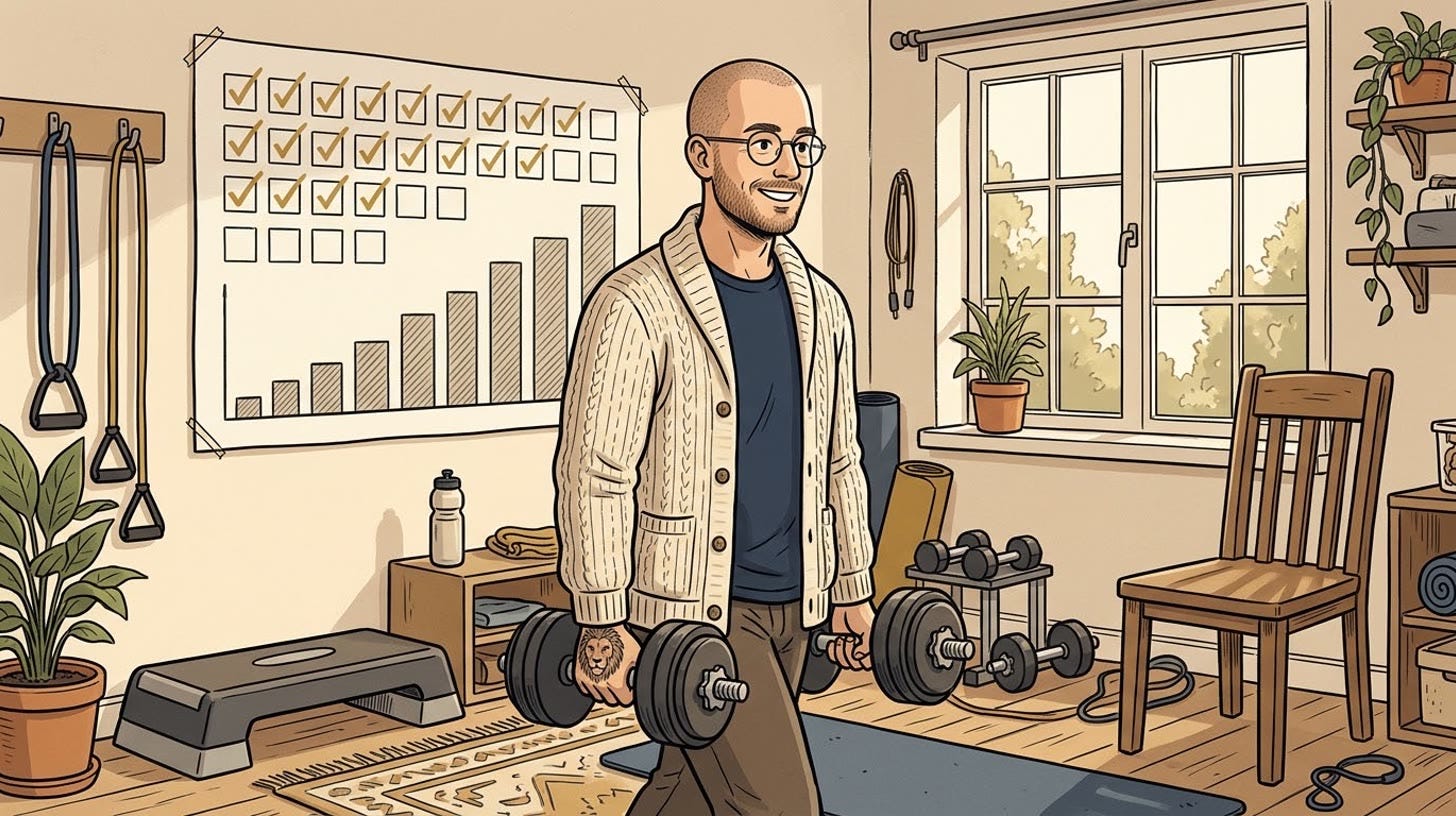
Maybe you've started before. You bought a set of dumbbells and brought them home all excited, or you printed a workout and taped it on the fridge. The first couple of weeks felt great. But then you weren't really sure if you should go heavier, do more sets or switch exercises, so you just kept doing the same workout with the same weights. Week six felt exactly like week two. And somewhere around week eight, a busy week came along, you missed a few days, and you never really picked it back up. And the thought you were left with was, "I guess this just doesn't work for me."
I want you to know that it does work for you. What was missing wasn't effort, and it wasn't willpower. It was a map: what to do each week, when to make it harder, and how to know you're actually making progress.
This week I wrote about the chair test and why strength matters so much after 60, and last week was all about getting enough protein on plants. So today I'm putting it all together into one plan. Twelve weeks, three sessions a week, built the same way we build programs for our members.
You Don't Start With the Mountain
Think about how someone gets ready for a big hike, the kind that takes all day and climbs a few thousand feet.
They don't start by driving to the mountain and trying to climb it on day one. They start with the trail by their house. A couple of weeks later they go a little longer, then they pick a trail with a few more hills, then they add a backpack. Every few weeks it gets a little harder, and their legs always have time to catch up. By the time they get to the mountain, it feels hard but doable, because they built up to it.
But here's what most people do with strength training. They walk the same flat trail every week, forever, and wonder why the mountain never gets easier. Or they go the other way and try to climb the mountain on day one, get sore and hurt, and quit.
In fitness we call this idea progressive overload. It just means doing a little more over time, in a logical way. It's the most important principle in strength training, and it's the one most people over 50 never get shown.
Strength Responds to Training at Any Age
One of the most famous studies on this was published in JAMA back in 1990. Researchers worked with frail nursing home residents aged 86 to 96. Ten of them did high-intensity strength training for their legs for eight weeks.
Their strength went up by an average of 174%, and their walking speed improved by about 48%. A couple of them didn't need their cane anymore to walk. And remember, these were people in their late 80s and 90s, many of them living with several health conditions.
That study changed the way researchers thought about aging muscle. Muscle doesn't stop responding when we get older. It just stops being asked to do anything.
And newer trials keep showing the same thing. In the IMPACT trial I wrote about last week, adults over 55 strength trained three times a week for 12 weeks and got stronger, whether they ate mostly plant protein or a standard diet. And in a Penn State trial where the average age was 74, even four minutes a day improved chair stands and balance in 12 weeks.
Twelve Weeks Is Long Enough to See Real Change
You might notice that a lot of these trials last about 12 weeks, and that's not an accident. It's long enough for your nervous system to learn the movements, which happens pretty fast in the first few weeks, and for your muscles to actually start growing and getting stronger, which takes a bit longer.
What we see with our members is that the first four weeks are mostly about learning the movements and building the habit. Weeks five to eight are when the strength numbers start climbing quickly. And weeks nine to twelve are when people start to see it in the mirror and feel it on the stairs.
Twelve weeks is also short enough that you can actually commit to it. You don't have to sign up for forever. You're signing up for one season.
Most Plans Fail at the Same Point
Here's the pattern I see over and over again. Someone gets a decent workout plan and does it with real effort. But they do the same workout with the same weights for months. Their body adapts in the first few weeks, and after that it has no reason to keep changing. Progress stalls, motivation drops, life gets busy, and they quit.
That's the same flat trail, every week. It never gets harder, so your legs never get stronger.
And the fix isn't a fancier workout. It's a plan that tells you exactly when and how to add a little more.
In the rest of this post, you'll get that plan: the three phases, every session for all 12 weeks, how much to add and when, home and gym options, what to eat on plants in each phase, how to adjust for sore knees, backs and shoulders, and the four checkpoints that show you it's working.
