Quick heads up from me: my YouTube channel was hacked this week and my YouTube was deleted. I am in the appeal process to get it back.
If you normally watch the podcast on YouTube, you can listen to this week's episode on Apple Podcasts or Spotify in the meantime. I will keep you posted.
Let me ask you something.
Has the scale been stuck in the same place for weeks? You are eating clean, you are trying, and nothing is moving.
I have good news. You are not broken, and your metabolism is not out to get you. In my years coaching over 1,200 people, a stalled fat loss almost always comes down to one of five things. And they matter in order.
Run through this checklist honestly, and fix the first one that is off before you touch anything else.
1. Your calorie deficit
You cannot redefine the laws of thermodynamics. If more energy comes in than goes out, your body stores the extra as fat. That is literally all fat is: stored energy for the future. Your body is excellent at its job.
Here is where most people get tripped up. A deficit works on a weekly average, not a daily report card. Say your target is 1,700 calories. Five great days at 1,700 plus a weekend at 2,300 puts your average well above target. You did not have a bad weekend. You simply were not in a deficit.
And one more truth. Online calculators give you a theoretical number based on people your age, height, and activity level. The world is not fair. Some people get to eat 1.5 times what I eat and get leaner. Others have to eat less than me. If you are doing everything right and the scale still will not move, you are not in a deficit yet, whatever the calculator said. That is just where your body is today.
2. Your daily movement
This is the one almost everyone underestimates. Let me show you where your body actually burns its calories each day.
About 60 to 70 percent goes to your BMR, your basal metabolic rate. That is the energy your body uses just to keep you alive, before you move a muscle. About 10 percent goes to digesting your food. Exercise? For most people, 5 to 10 percent, and most of us are closer to 5. That is half of what your body spends digesting lunch.
The real lever is NEAT, your non exercise activity thermogenesis. Your daily movement. Walking, fidgeting, taking the stairs, living your life on your feet. That is 10 to 15 percent of your daily burn, and it is the biggest piece you can actually change day to day, though the exact share varies a lot from person to person.
That is why I tell our clients to aim for 10,000 steps a day. There is nothing magical about the number. Research shows most of the health benefit lands around 7,000 steps, so if 10,000 feels out of reach, 7,000 is a strong target. It just forces you out of the chair and off the couch. And here is the beautiful part. For many people, an hour long walk barely moves hunger, while an hour of hard training leaves them starving. More movement, less hunger, more fat loss.
3. Your strength training
Notice I did not put cardio here. Strength training comes first, and not for the reason most people think.
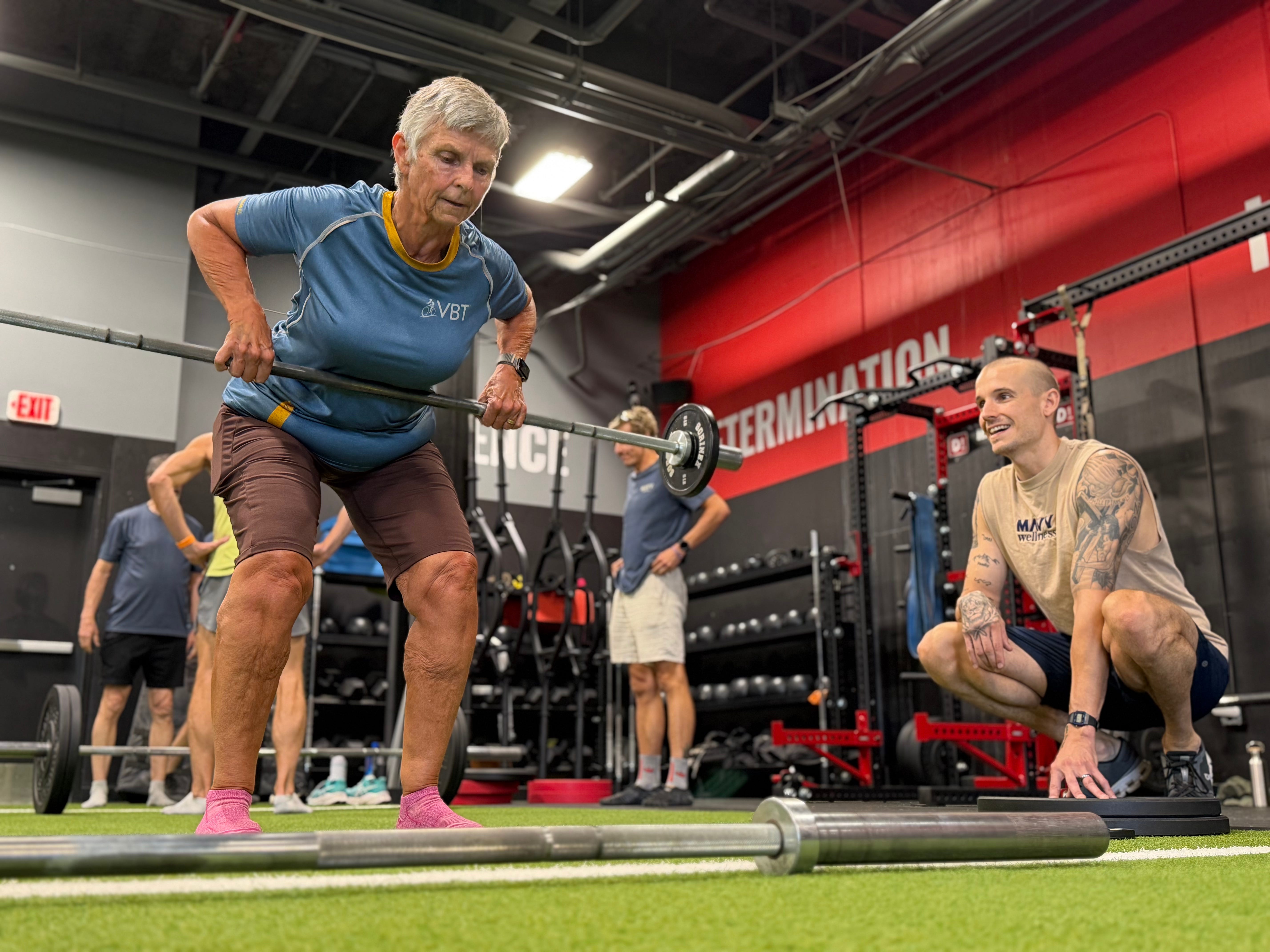
You do not lift weights to burn calories. You lift to build muscle, and muscle raises your BMR, which means you burn more at rest and you get to eat more food while staying in a deficit.
After 50, this becomes non negotiable. Muscle naturally declines with age, and so does bone density. Strength training fights sarcopenia, the loss of muscle, and osteopenia, the loss of bone. You need that pressure on the bones to keep them strong. It works best alongside weight bearing movement and enough calcium and vitamin D. If you have been diagnosed with osteoporosis, keep your doctor in the loop instead of relying on exercise alone.
Three to four sessions a week is the target. Not to torch calories. To build a body that burns more of them on its own.
4. Your protein
Protein will not move the scale much by itself, but it decides what the scale is measuring when it does move.
When you train, you are asking your muscles to get stronger. Protein, or more precisely the amino acids inside it, is what rebuilds them. Eat enough and the weight you lose comes from fat. Eat too little and you lose muscle along with it, which is the exact opposite of what we want after 50.
Aim for about 1.6 grams per kilogram of your ideal body weight. Ideal, because we do not need to feed the extra fat, only the body you are building. That 1.6 figure comes from research using total body weight, and in a calorie deficit the evidence points higher, often 2.0 grams per kilogram and up, to protect muscle. If you have kidney issues or a chronic condition, check with your clinician before pushing protein higher.
5. Your cardio
Cardio burns a bit more than strength training, and it is a fine tool for creating a bigger deficit. But I want to be clear on this one.
I want you to lose 10 pounds of fat, not just be 10 pounds lighter. There is a difference. And beyond fat loss, cardio makes your heart stronger. You can have a flat stomach and big biceps, but if your heart gives out, none of it matters.
So yes, keep cardio in the plan. Just know its real job.
How to use this
Go in order. If your deficit is off, fix that first and change nothing else. If your steps are at 3,000, get them to 10,000 before you touch your food. One lever at a time, so you actually know what worked.
And if all five are dialed in and the scale still will not budge? Create a slightly bigger deficit. Drop about 100 calories, or add 20 to 30 minutes of easy zone 2 cardio for the week. Keep your intake at a sensible floor, and if you take medication or manage a health condition, check with your clinician before cutting further. Small moves, honestly tracked, beat dramatic overhauls every time.
One more thing. Eating whole food plant based makes every item on this list easier. The food is high in volume and low in calories, rich in fiber, and it keeps you full. Staying in a deficit stops feeling like a fight.
Want the full framework?
On October 13th, Ivy and I are teaching a free live masterclass on exactly this: how to lose your next 10 lbs after 50. We are going deep on all five of these, plus the mindset foundation, plus how to adjust your plan the moment your body adapts and stalls.
There is no replay. It is live, you can ask us questions, and we would love to see you there.
Save your seat here: https://mavywellness.com/live
See you there,
Maxime
Co-Founder Mavy Wellness