
Good morning,
I hope you all had an incredible week.
I’m back online from my digital detox, Ivy and I had a blast heading down to Malibu to enjoy the beach, some hikes and time in nature (mainly because we were escaping the Las Vegas heat).
I’m excited to write today’s newsletter, to answer your questions support you on. your whole food plant-based body recomposition journey ☺️
Before we jump into answering questions, just a reminder to send in your questions that you want answered by replying to this email or commenting under this article on Substack ahead of time (I write my newsletters every Wednesday for that Saturday just so you know).
The first question/comment that we got is coming in from Tina, who knows me from way back in the day when I used to have a nickname called Luckie ;)
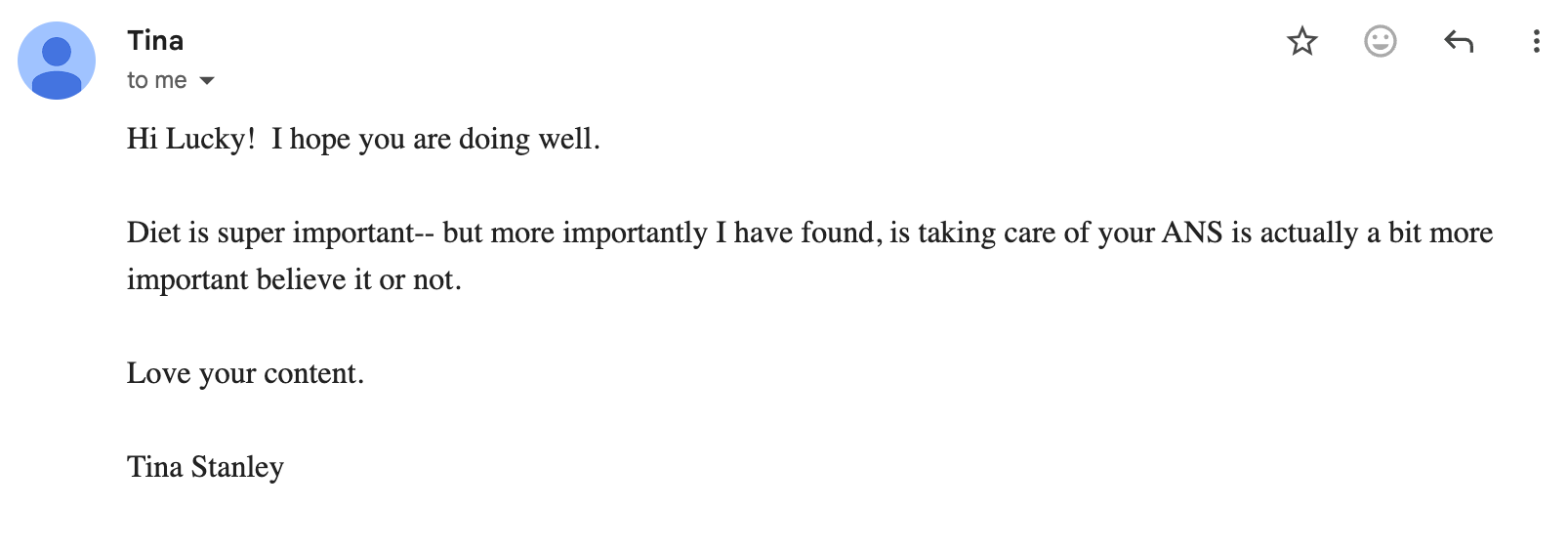
Now I know that this isn’t a question, but I thought it was valuable to add to this week’s newsletter. In reply, she’s referring to the autonomic nervous system, which regulates involuntary body functions such as digestion, heart rate, breathing, and stress response: the sympathetic fight-or-flight and parasympathetic rest-and-digest state. Basically, she’s referring to how managing stress plays a major role in fat loss and overall health.
I think that we’ve been seeing that with a lot of plant-based influencers/personalities in this space with my own journey. That’s why, everywhere on Wednesday when I write my soul posts, I’m trying to talk about that as well. Back of a transformation, on the weekly newsletter, I talk about the fitness and nutrition component, but I think it’s something that more people are becoming enlightened to: that stress is playing a bigger role than they initially thought in their transformation.
If you’re reading this and you’re struggling with your body composition, and you are compliant and actually in a calorie deficit, strength training, and doing cardiovascular exercise consistently for months, and your body is feeling a little bit stuck, then I would start looking at reducing stress in other areas of your life that could be hindering your transformation and ultimately the quality of your life as well.
Which is why I’m not a fan of really strict dieting, where you can only eat X food for lunch and you can’t have carbohydrates or things that kind of eliminate a certain macronutrient.
That’s why I’m a fan of learning how to eat out at the restaurant, because you’re going to have date nights with your partner. You’re going to go to birthday parties, and you’re going to go to family dinners and gatherings. You need to learn how to navigate all of these things and not be the obsessive person that brings their scale with all of their food prep and is not able to enjoy the moment with everyone there.
The relaxation part of the food and operating within guidelines versus strict rules makes a tremendous difference in the long run in ensuring that you have a healthy relationship with food, with your body, with yourself, and with exercise. I say thank you, Tina, for bringing that up.
Now let’s transition to Alexandra’s question. We’ll talk a little bit more about the vegan side of things.

First of all, hey Alexandra, hope you’re doing well. It’s always great to hear from you, and I think it’s a fantastic question. I have an honest answer for you. I can obviously go down the logical road by answering this question, which is that plant-based whole foods contain more fibers and vitamins and nutrients, which would satisfy your receptors and fill your gut faster because of the fiber. You’re actually going to feel fuller. Yes, potatoes are very filling. Rice is very filling. If you eat plant-based proteins such as tofu, tempeh, edamame, beans, and lentils, that’s also going to be very satiating as well.
From my personal experience, when someone says something like this, it’s not a logical argument. It is a self-justification argument. They’re just trying to explain to themselves why they can’t do it, because they couldn’t live without it, because they don’t feel full if they eat that thing. The honest truth is that they probably have never tried to do it, or if they tried, it wasn’t for long enough of a period of time where the gut bacteria was able to fully shift over to being healthier and to getting used to eating on a plant-based whole food lifestyle. If they’ve tried, they probably tried some version of junk food vegan, or they are severely eating on their calories because they didn’t know how to structure their meal. They didn’t have a good experience because they didn’t do it properly. Just like anything else that you don’t do properly, you’re not going to have a good experience with it.
Is it the fault of the way of eating, or the fault of the person for not doing it properly? I think it does warrant some research and guidance when people transition to make sure they do do it properly. In the case of your email, I would say it’s more of a psychological thing for him versus a logical argument, because yes, eating whole food plant-based is way more satiating than eggs and meat. I hope this helps.
And that was pretty much it for the questions that were submitted from last week’s newsletter. If you have any that have come up for you while you’re reading this, either about fitness and protein and body composition and training or anything like that, please ask them down below in a substack section or reply to the email. I block off an hour every week to go in depth and answer the questions so I can help you as best as I can for free on here in your transformation.
As soon as we launch our Forever Fit course, which also comes with 12 months of access to a community, weekly group calls with IV&I for coaching, and our Forever Fit software, we can build your own workout program and meal plan and track your habits and track your workouts and your progression and your transformation.
As a part of one of those group calls, I did receive some interesting questions on my last call on Monday, when I came back from digital detox. One of them was the calorie-to-protein debate: what happens when you’re at the end of the day and you’re short on your protein, but you don’t have a lot of calories left? In order to hit your protein goal, would you have to go over your calories? Now, which one do you honor? Do you respect the calories, or do you go over your calories to hit your protein goal for the day?
My answer to this is, as your indirect coach for this newsletter, always respect the calories. If you do not hit your protein within your calorie target for the day, that is just a cost of not having planned your food properly. Just take the hit, move on to the next day. You need to learn how to make your protein fit within the day. Again, one day if you’re short, it’s not the end of the world, but to do it consistently is when you’re going to start having issues with your body composition and transformation and everything getting slower and potentially losing more muscle.
The calorie target is very important, especially if you’re in a body recomposition phase, because if you go over, you’re canceling your deficit. Therefore, you’re canceling the environment that would be conducive to you losing fat, because remember, fitness builds the body, nutrition reveals it. Nutrition reveals it by being in a calorie deficit, by creating a state where there’s less energy coming in than there is going out.
In that state, in order to not lose muscle and to build some muscle, we are focusing on hitting our protein target, which is a combination of amino acids and building blocks to repair the tissue that’s being damaged through your strength training sessions every week.
So, long and short, respect your calories. If you did hit your protein too bad, that’s just a cost of not having planned properly for that date. Try again the next day.
I hope this helps some of you, because I know that it is a bigger struggle that people have when they’re eating whole food plant-based and hitting their protein. It kind of gets into our Mavy Wellness world of wanting to improve their body composition over the age of 50, and you realize how important protein plays a role in being able to improve your body composition in a favorable way.
And so I want to add, for those of you that do want everything taken care of for them, I would invite you to look into our one-on-one custom coaching program, Mavy Wellness, that we’ve been running for over six and a half years with our incredible team of coaches.
If you’re someone that wants to learn the details of how to build your workout plan, how to build your meal plan, how to adjust everything as your body progresses and plateaus, and that wants the education piece and that wants to learn how to build their own workout and have group accountability via group calls in our community, then I invite you to check out our Forever Fit course and community.
That way you can pick the one that aligns best with you, but regardless of which one we pick, Ivy and I look forward to serving you in your transformation, even if it’s just through the newsletter and our YouTube/podcast content. I hope you have a fantastic weekend. Thank you for taking the time to read, and all the links mentioned will be down below in my signature.
Sincerely,
Maxime
📖 Read the Forever Fit Book → Here
🎓 Forever Fit Course/Community → Here
💪 Custom 1:1 coaching → Here
Ps. Check out our latest success story episode with Brenda 👇
