

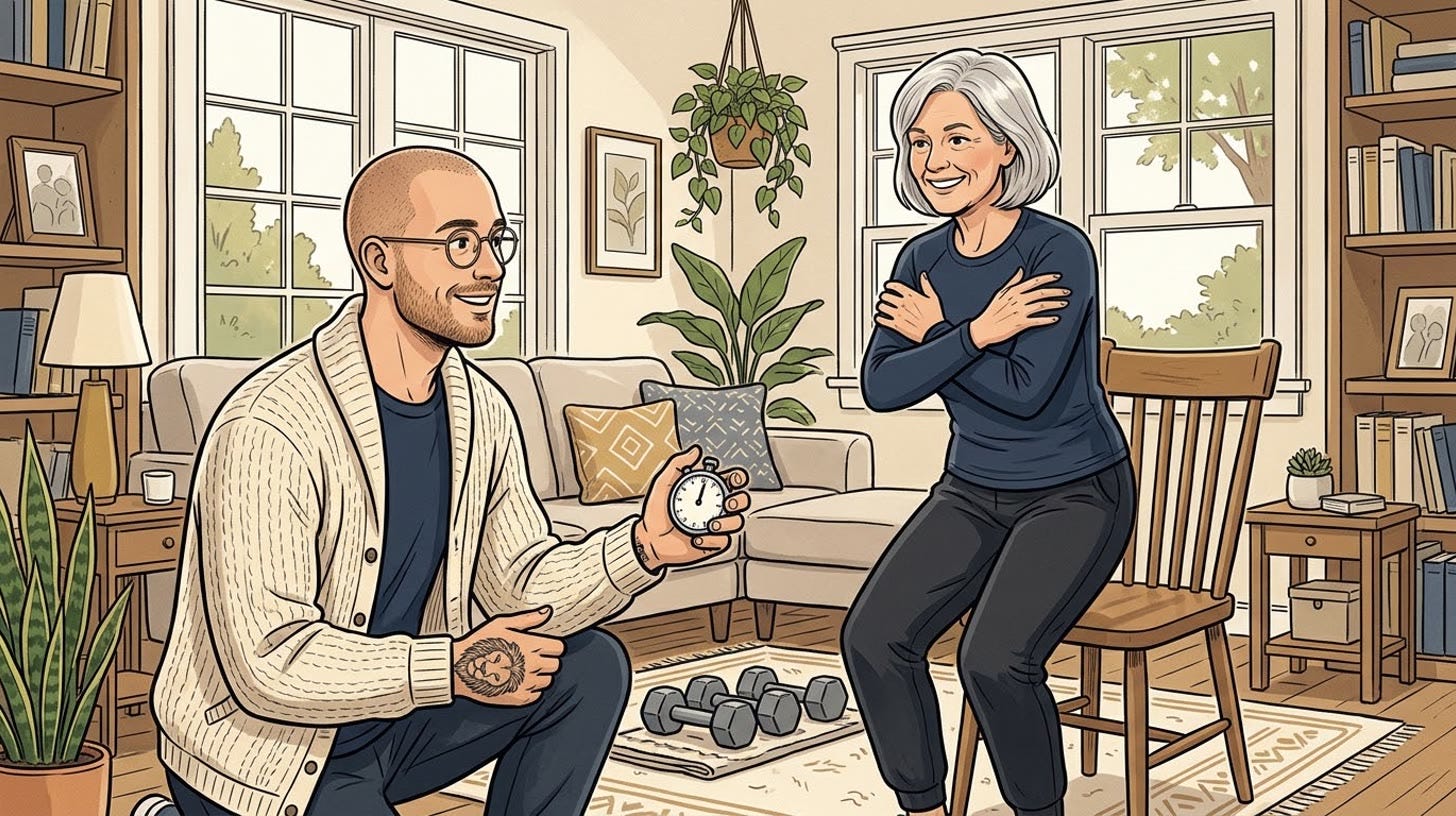
You know that moment when you're sitting on a really soft couch at a friend's place, and when it's time to get up, you have to scoot to the edge, put a hand on the armrest and kind of rock yourself forward to stand? Nobody else notices it, but you do, and on the drive home you catch yourself wondering when that started getting so hard and whether this is just what getting older looks like now.
I hear some version of this from people over 60 all the time. "I get up from the floor like a toddler." "Two flights of stairs and my legs are done." And most of the time they say it with a little laugh, like it's just part of the deal, so they file it under "getting older" and move on.
I want to show you why those little moments are actually worth paying attention to. Not because they mean something bad is coming, but because the strength behind them is something you can measure, and more importantly, something you can build back. A big study came out this year that makes this really clear, and at the end I'll show you how to test yourself in your own kitchen tonight.
How Engineers Know a Bridge Is Safe
Before a new bridge opens to traffic, engineers do something that surprises a lot of people. They drive big, heavy trucks onto it, park them in specific spots, and measure how much the bridge bends.
They're not checking whether the bridge can hold today's traffic, because they already expect it to. What they're really measuring is its reserve, meaning how much extra weight it can handle before it gets into trouble. A bridge with plenty of reserve handles a storm, a traffic jam or 50 years of wear without a problem. A bridge with very little reserve can look perfectly fine right up until the day it isn't.
And here's the thing. Your legs and your hands are your bridge. You cross it every time you stand up, climb a step, carry your groceries or open a jar. For years you have so much reserve that you never even think about it. Then slowly, as muscle fades, that reserve gets smaller, and one day the soft couch becomes the test.
The chair test and grip strength are your load test. They show you how much reserve you have left, and this study shows just how much that reserve matters.
Stronger Grip Went With a Lower Risk of Dying
The study was done by researchers at the University at Buffalo and published in February 2026 in JAMA Network Open. They followed more than 5,000 women between 63 and 99 years old for about eight years.
At the start of the study, every woman squeezed a grip strength device and did a timed chair test, standing up and sitting back down five times as fast as she could with her arms crossed. Then the researchers followed them for the next eight years.
What they found was really consistent. On average, every 7 kilograms of extra grip strength went with about a 12% lower risk of dying during the study. To give you an idea, 7 kilograms is roughly the difference between a weak handshake and a firm one.
Now, this was an observational study, so it shows a link, not proof that a stronger grip by itself makes you live longer. But it's a strong and steady link, in a big group of women who look a lot like many of you reading this.
Faster Chair Stands Told the Same Story
The chair test pointed in the same direction. The women who could stand up and sit down five times faster had a lower risk of dying, about 4% lower for every six seconds faster.
Six seconds doesn't sound like much on paper. But in real life, it's the difference between getting up off that couch in one smooth movement and having to rock forward two or three times first. That's the reserve in your bridge.
The lead researcher said something along the lines of: when we can no longer get out of a chair and move around, we're in trouble. I like to flip it around. When you can get up easily, you keep your freedom. You keep traveling, gardening, getting down on the floor to play with your grandkids, and getting back up again without needing someone to pull you.
Strength Mattered Even Without Much Cardio
This is the part that surprised me the most. The researchers wanted to make sure this wasn't just about women who exercised more in general. So they took into account how much the women walked, their overall activity, inflammation and body size.
And the link was still there. It was even there for the women who weren't meeting the usual cardio guidelines.
So in other words, strength mattered on its own. You don't have to become a runner or do an hour of cardio a day for your strength to count. If you love walking, that's amazing, please keep walking. It's great for your heart and your mood. But the muscle in your legs and hands is its own part of the bridge, and it needs its own kind of training.
Strength Can Come Back Fast, Even in Your 70s
Now here's the hopeful part, and it's the part I really want you to hear. Strength is one of the most trainable things about your body, at any age.
In a Penn State trial published this year, 97 adults with an average age of 74 did only four minutes of strength exercises a day. Four movements, 30 seconds each. Before the study, they were only exercising about 18 minutes a week. After 12 weeks, they could do about four more chair stands in 30 seconds, they could stand on one leg longer, and they could get up from a chair faster.
Four minutes a day. Not an hour at the gym. That's how quickly your bridge can start gaining reserve again once you give it the right load.
And in another trial this year, adults over 55 who strength trained three times a week for 12 weeks improved their chair test whether they ate mostly plant protein or a regular diet. So if you're plant-based, guess what? Your food is not what's holding you back from getting stronger.
None of This Means You're Falling Apart
If you had to rock yourself off the couch last weekend, I want you to know that nothing is wrong with you and you haven't failed at anything. Your bridge just hasn't been asked to carry much in a while. Muscle that isn't challenged slowly fades at every age, and it starts responding again as soon as you challenge it. That's how the body works, whether you're 35 or 85.
How to Test Yourself Today
This is the same chair test the researchers used, and it takes less than a minute.
What you need: a sturdy chair with no wheels, pushed up against a wall so it can't slide, and a phone with a timer.
How to do it:
1. Sit in the middle of the chair with your feet flat on the floor, about hip width apart.
2. Cross your arms over your chest.
3. Start the timer, stand all the way up, then sit all the way back down. That's one.
4. Do five as fast as you safely can, then stop the timer.
Write your time down. If you can't do five without using your hands, that's totally fine and it's still useful information, so just write down how many you did. If you have a balance or joint concern, have someone stand beside you, or use your hands lightly and make a note of it.
For grip, you don't need a fancy device to start paying attention. Notice how hard it is to open jars, how long you can carry your grocery bags, and whether your hands get tired holding a book. Those are your everyday grip tests.
Then redo the test every four weeks. Watching your time go down is one of the best signs that your training is working, and it often shows up long before the scale moves.
How to Make Your Bridge Stronger
Once you have your number, here's how I'd start improving it.
Practice the test itself. Sit to stand is honestly one of the best leg exercises out there. Do 2 or 3 sets of 8 to 10 on most days. When it gets easy, use a lower chair or hold a weight at your chest.
Train your whole body two to three times a week. Add a push (wall or counter pushups), a pull (a row with a band or a dumbbell), a hinge (pushing your hips back, like closing a car door with your bottom) and a carry (walking with a bag in each hand). The carry is a great grip exercise too.
Make it a little harder over time. One more rep, a slightly lower chair, a slightly heavier bag. A little more load, added often, is how you build reserve.
Feed your muscles. Muscle needs protein to rebuild. We aim for about 1.6 grams per kilogram of your ideal body weight, spread out across your meals, from foods like tofu, tempeh, lentils, beans and a plant protein powder.
On Friday, paid members get the full version: The 12-Week Muscle-on-Plants Plan, with every session laid out week by week, how to progress safely, and how to eat for it on plants. It's the whole roadmap from your first chair test to your strongest one.
What Doesn't Work
Avoiding hard things to protect yourself. I get it, it feels safer to always use the armrests and take the elevator. But muscles that never get challenged keep shrinking. The safest thing you can do is challenge them gently and often.
Only walking. Walking is wonderful and I want you to keep doing it. But in this study, strength mattered on its own, and your legs need resistance to get stronger.
Waiting until you feel stronger to start. I hear this one a lot. Strength doesn't come before training, it comes from training. Start where you are, even if that's five chair stands using your hands.
Do Your Load Test Tonight
So here's your one thing for today. Tonight, before dinner, do the five chair stand test and write down your time and the date.
That's your load test. Engineers don't wait for a bridge to show cracks before they measure it, and you don't need to wait until getting off the couch becomes a real struggle to check your strength either.
And I'd love for you to share your time in the comments, with your age if you're comfortable. No judgment at all, it's just a starting line. You'll be surprised how many people are right there with you, and how fast those numbers come down once you start.
If you'd like help building the strength behind that number, Ivy and I are teaching a free live masterclass this Saturday, November 14 at 9 AM Pacific: How to Build Muscle on Plants and Get Stronger After 50. We'll show you exactly how to train, what to eat and how to make it stick. Register at mavywellness.com/live.
Sincerely,
Maxime Sigouin
Co-founder of Mavy Wellness
Author of Forever Fit
Get your copy here, free worldwide shipping.
References
LaMonte M. et al. Muscle strength and mortality in women aged 63 to 99, JAMA Network Open, February 13, 2026. Summary: University at Buffalo, February 23, 2026. https://www.buffalo.edu/ubnow/stories/2026/02/muscle-strength-longevity.html
Sciamanna C. et al. FAST-2: brief daily functional strength training in adults 65 and older, PLOS One, 2026. Summary: Penn State Health News, June 2026. https://pennstatehealthnews.org/2026/06/four-minutes-of-daily-resistance-training-can-quadruple-fitness-in-older-adults/
van Oppenraaij S. et al. Plant protein and resistance training in adults aged 55 and older: the IMPACT randomized trial. American Journal of Clinical Nutrition, 2026. https://pubmed.ncbi.nlm.nih.gov/42772454/