

The short answer: yes. Stefano Passarello is an Ironman athlete who went plant-based purely for performance, and it took him all the way to the Ironman World Championship in Kona, Hawaii, where he ran one of the fastest marathon splits in his age group. His lessons apply far beyond racing: choose slow, steady fuel instead of quick sugar, adapt your training when your body changes instead of quitting, remove the friction that stops you from working out, keep most training at an easy pace, and train and eat with other people. You don't need to race an Ironman to use any of it.
You might be thinking, "That's great for an elite athlete. I'm 66 and I just want to get off the floor without help." And that's totally fair. I'm not asking you to go swim 3.8 kilometers. But when someone who trains at that level says plants made him better, it's worth hearing why, especially if you've ever worried that eating plant-based is holding you back.
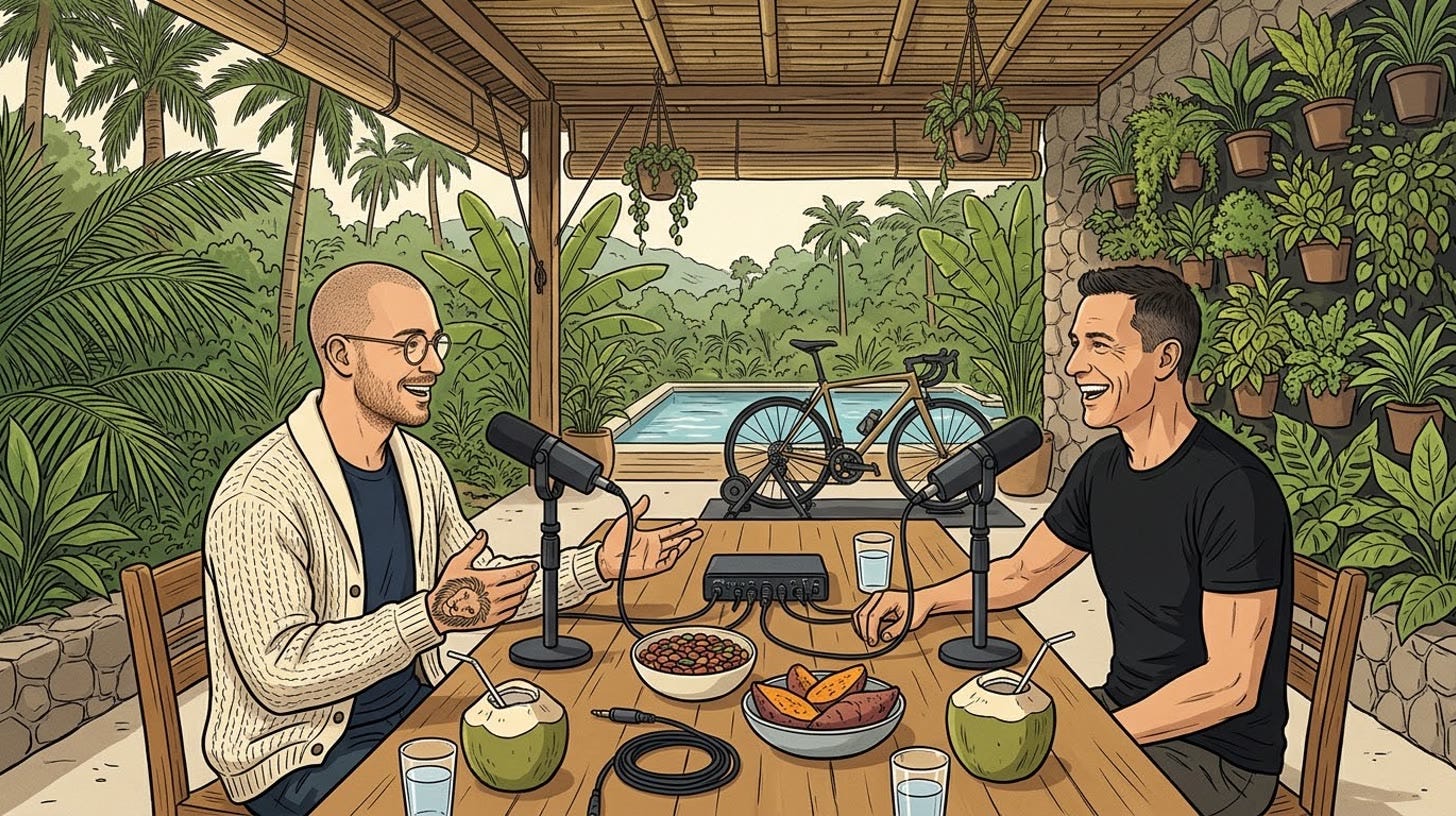
I recorded this conversation with Stefano at Kapuhala, the plant-based eco resort he co-founded in Koh Samui, Thailand. Here are the six lessons I took from it for anyone over 50. The full episode is at the bottom.
Why did an Ironman athlete go plant-based?
Stefano was really honest with me about this. He didn't go plant-based for ethical reasons. He did it entirely for performance.
His speed and endurance come from volume, from the hours he trains. So he was looking for anything that would help him recover faster, sleep better and feel better day to day. Whole food plant-based eating was what worked for him. He also has a demanding career in finance and tax, and he says he thinks more clearly when his eating and training are dialed in.
And I could totally relate to that, because I went plant-based for a physical reason too. I used to weigh 240 pounds as a bodybuilder, then I needed to slim down for high fashion modeling. Everyone seems to have one entry point into plant-based eating, and then all the other reasons show up after.
How does a plant-based athlete keep steady energy?
This was my favorite part of the conversation. Stefano chooses foods that give him slow, steady energy instead of quick spikes. His favorites for long training days: beans, squash and pumpkin, sweet potatoes and yams, dried fruit like raisins, almonds and other nuts, and coconut water. After races, he likes salted almonds.
He explained it with an image I keep coming back to. Quick sugar is like throwing hay or dry twigs on a fire: a big flame, then it's gone and you need more. Whole plant foods with fiber are like a big log. They burn longer and more steadily.
He said that applies to more than racing. It applies to work and to family life. When your energy is steady, your mood is steadier too, and life just goes better.
For most people over 50, this isn't about race fuel. It's about not crashing at 3 PM and reaching for whatever's in the pantry. Build your meals around beans, lentils, whole grains, vegetables and a protein anchor, and you'll feel that big log effect.
What happens when your body won't let you train the way you used to?
Stefano was a very strong runner. Then, as he got a little older, the injuries started: Achilles, knees, one thing after another. He couldn't run anymore. So he started cycling. When cycling started to bother him, he added swimming.
At the end, as he put it, he was an injured runner who had covered all three sports. So he tried a triathlon. He won it. That eventually led him to Kona.
This is one of the most important lessons for anyone over 50. When your knees, back or shoulders complain, the answer is rarely to stop moving. It's to adapt: a different exercise, a different range of motion, a lighter weight, a different machine. Our members do this all the time. A sore knee might mean box squats to a higher seat instead of deep squats. The goal stays the same. The path bends.
How do you keep working out while traveling?
Stefano takes about 100 flights a year. So I asked him how he keeps his training going on the road, since it's one of the most common struggles our members have.
His answer was simple and a little funny: sleep with your shoes on. He doesn't literally mean it every night. He means remove every bit of friction between you and the workout. Know where the gym is. Lay out your clothes. Make the workout come before almost anything else in the morning, even before brushing your teeth in order of priority.
After a long flight he goes straight to a quick workout and says he feels fresher at the office than people who didn't train at all.
You can borrow this without flying anywhere. Put your walking shoes by the bed. Leave your resistance band on the kitchen chair. Decide the night before exactly what you'll do and when. The easier the first step, the more often you'll take it.
How hard should most of your training be?
Here's what surprised a lot of listeners: Stefano trains every day, sometimes several short sessions a day, but most of it is easy. He follows the Maffetone method, which keeps most training at a low heart rate, roughly 180 minus your age as a ceiling, often called zone two. Only a small part of his week is hard.
You're probably not training for an Ironman, and you don't need to train every day. But the principle holds. Your daily walking should feel easy enough that you could hold a conversation. Then your strength training, two or three times a week, is where you push: sets that end when you could only do one or two more good reps.
Easy most of the time, hard some of the time. That's how you keep going for years instead of weeks.
Why does community matter as much as food and training?
Stefano and his wife built Kapuhala in Thailand and in Sicily, inspired by the Blue Zones, the places in the world where people tend to live long, active lives. He pointed out that what those places share isn't only plant-rich food. People move naturally all day, and they live, eat and celebrate together.
He believes loneliness is one of the biggest hidden threats to our health, and that training together and eating together put everything on a different level.
That's exactly what we see with our members. The weekly group calls, the check ins, knowing someone noticed you showed up. That's often what turns a plan into a lifestyle.
You win the race every day you wake up
Stefano ended with something he tells his son. You don't win the race on race day. You win it every day you wake up and don't feel like it, and you show up for the workout anyway. When you do the extra set. When you're so tired you could fall asleep at the dinner table.
And when you finally cross the finish line, he said, the best part is having your family waiting on the other side.
Your finish line might be hiking with your grandkids, traveling without worrying about the stairs, or simply getting off the couch in one smooth motion. Either way, it's won on the ordinary days.
Key takeaways
Plants and high performance go together. Stefano went plant-based purely for recovery, sleep and performance, and raced at the Ironman World Championship.
Choose the big log, not the hay. Beans, squash, sweet potatoes, nuts and dried fruit give steadier energy than quick sugar.
Adapt instead of quitting. Injuries pushed him from running to cycling to swimming, and into triathlon.
Remove the friction. Lay out your shoes, plan the session, and train first.
Easy most days, hard some days. Keep walking easy and push in your strength sessions.
Train and eat with people. Community is part of the plan.
Listen to the full conversation
Timestamps
00:00 Highlights: you win the race every day you wake up
00:30 Meet Stefano and why he went plant-based for performance
03:29 Plant-based for the brain, recovery and performance
04:08 His Ironman journey, from Hong Kong to racing Kona
07:25 How plant-based athletes manage their energy
09:34 Race day fuel and avoiding the wall
14:49 Growing up plant-based in Italy
16:44 Building a plant-based resort
19:38 Longevity and feeling well every day
20:50 Training: swim, bike, run, and 21 sessions a week
26:03 How he trains while traveling
28:34 Blue Zones and why loneliness matters
30:38 Resort life, community and recovery
32:33 Racing mindset and wrap-up
About Stefano: Stefano Passarello is an Ironman athlete and co-founder, with his wife, of Kapuhala, plant-based eco resorts in Koh Samui, Thailand and Sicily, Italy. He has raced at the Ironman World Championship in Kona and works in finance.
Kapuhala Koh Samui: https://kapuhalasamui.com · Kapuhala Sicily: https://kapuhalasicily.com/?lang=en
This week I also wrote about a simple chair test and what a study of more than 5,000 women over 60 found about strength. Tomorrow, paid members get The 12-Week Muscle-on-Plants Plan, the full roadmap week by week.
What's your "shoes on" trick? The one thing that makes it easier for you to show up for a workout. Share it in the comments.
And this Saturday, November 14 at 9 AM Pacific, Ivy and I are teaching a free live masterclass: How to Build Muscle on Plants and Get Stronger After 50. Register at mavywellness.com/live.
Sincerely,
Maxime Sigouin
Co-founder of Mavy Wellness
Author of Forever Fit
Get your copy here, free worldwide shipping.
Maxime Sigouin is the co-founder of Mavy Wellness, author of the #1 bestseller Forever Fit and host of the Forever Fit Podcast. He and his team have coached over 1,300 adults, most of them over 50, to build muscle and lose fat on a whole food plant-based lifestyle.