

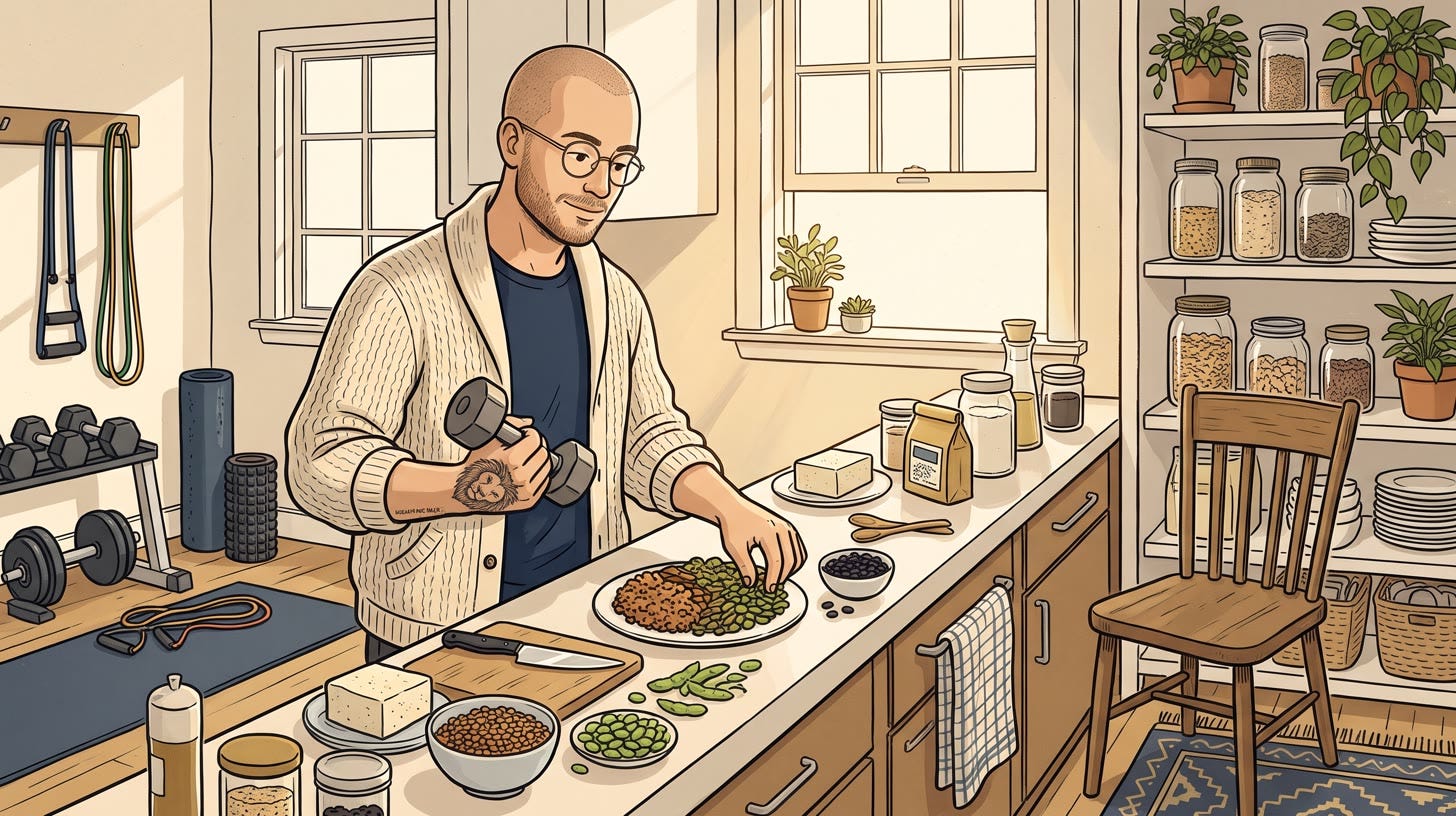
You're at a family dinner, and someone at the table finds out you eat plant-based. They lean back in their chair and ask you the question you've heard a hundred times: "But where do you get your protein?" You give them the usual answer, beans, lentils, tofu, and the conversation moves on. But later that night, when you're putting your shoes on and your legs feel a little weaker than they used to, a small voice in the back of your head says, "Maybe they have a point. Maybe you just can't build muscle on plants after 55."
I completely understand why that doubt creeps in. Most of what you see online about building muscle comes from young guys in the gym eating in a way you chose not to eat. So when your strength starts slipping, it's natural to wonder if your plate is the reason.
A new trial came out this year that tested exactly this question, in people who look a lot like the readers of this newsletter. And the answer is a lot better than the doubt. It does come with one honest catch, though, and I think that catch is going to change the way you plan your meals.
Think of Your Muscle Like a Brick Wall
The way I like to explain this to our members is to picture your muscles like a brick wall that a crew is building.
Strength training is the crew. Every time you do your squats, your pushups or your rows, you're sending the crew to the job site and telling them to build. That's the signal. Protein is the bricks. The crew can show up every single day and work as hard as they want, but if the truck only drops off half the bricks they need, the wall only gets built halfway.
And here's the thing most people miss. You can have the best crew in the world, a great workout plan, perfect form, three sessions a week, and still be short on bricks. That's what I see over and over with plant-based people over 50. The crew is working. The bricks just aren't showing up.
Keep that picture in mind, because that's exactly what this study ended up showing.
Plant-Based Adults Over 55 Got Stronger in 12 Weeks
The study is called the IMPACT trial. It was run by researchers in the Netherlands and published in 2026 in the American Journal of Clinical Nutrition, which is one of the most respected nutrition journals in the world.
They recruited 108 adults aged 55 and older. The median age was 66, and 58% of them were women. That's almost exactly the people I coach every day.
For 12 weeks, everyone did the same thing: strength training three times a week. Then the researchers split them into two groups. One group was coached to get most of their protein from plants, and the other group ate a standard diet. Both groups were asked to get at least 1.2 grams of protein per kilogram of body weight per day.
And here's the big headline. Both groups got stronger. Their leg press strength went up, and their chair stand test, which is a simple measure of how easily you can get up from a seat, improved. On strength and function, there was no difference between the two groups.
So if you've ever doubted yourself at that dinner table, I want you to read that one more time. Eating mostly plants did not stop people over 55 from getting stronger.
Both Groups Built Muscle, Just Not the Same Amount
Now let's talk about the catch, because I'd rather give you the full story than the easy one.
Both groups also gained muscle in their arms and legs. The plant group gained about 0.38 kilograms, and the standard group gained about 0.66 kilograms. So the standard group built more.
When you look at what they ate, the reason jumps right out. The plant group hit the target, about 1.24 grams of protein per kilogram per day, with roughly 76% of it coming from plants. The standard group went way past the target and ate about 1.58 grams per kilogram per day.
So the group that ate more protein built more muscle. The researchers were careful about this. Because the two groups didn't eat the same amount of protein, they couldn't say whether plant protein builds muscle just as well gram for gram. What the study does show is that both groups improved their muscle, strength and function, and that the plant group simply ate less protein.
Same crew, same effort, same hours on the job. One wall just got fewer bricks.
The Gap Was Protein, Not Plants
This lines up with what I've seen with almost every plant-based person over 50 who comes to us feeling stuck.
So many of our members tell us some version of the same thing: "I eat so well. I know nutrition. So why do I feel weaker?" And when we sit down and look at their food together, the meals are beautiful. Vegetables, fruit, whole grains, beans. But the protein is often around 40 to 60 grams a day, when their body is asking for something closer to 90 to 130.
That's not a plants problem. It's a planning problem. Whole food plant-based eating is amazing for your health, but nobody designed it with building muscle after 50 in mind. A lot of plant foods are very filling and lower in protein per bite, so it's really easy to feel full long before you've eaten enough protein.
A separate study from 2025, published in the Journal of Nutrition, looked at active older adults and found that a well-planned vegan diet didn't lower their daily muscle building compared with a standard diet. The key words there are "well planned." The plants can absolutely do the job. The plan is what makes sure they do.
Why This Matters More After 55
We actually start losing muscle in our 30s, and after 50 that loss speeds up. That's why the same meals that kept you strong at 40 might not be enough at 65.
On top of that, older muscles respond a little less to protein than younger ones. Researchers call this anabolic resistance. In plain words, your muscles need a slightly bigger signal to grow than they used to. That means a bit more protein at each meal, and regular strength training to tell your body that the protein has a job to do.
And that's the good news hidden inside this trial. The two things that make the difference are simple, and they're both in your hands: keep the crew working, and make sure the bricks show up.
None of This Is Your Fault
If you've been eating plant-based for years and you still feel weaker, I want you to know you didn't do anything wrong. Nobody ever handed you a protein number. You were told to eat whole foods and you did, beautifully. You just were never shown how much protein your muscles need after 50, or how to get it on plants.
How to Close the Protein Gap on Plants
Here's how I'd start, the same way we start with our members.
Know your number. The trial's target was 1.2 grams per kilogram of body weight per day. For someone who weighs 150 pounds, that's about 82 grams. With our members, I usually aim a little higher, around 1.6 grams per kilogram of their ideal body weight, because in this study more protein went with more muscle. Start where you are and build up over a few weeks.
Give every meal a protein anchor. Most people get almost all of their protein at dinner. Try to spread it out to around 25 to 35 grams at each main meal. Tofu or tempeh, lentils, beans, edamame, soy milk and a plant protein powder all work great as anchors. Then build the rest of the plate around them.
Fix breakfast first. For most plant-based eaters I meet, breakfast is the weakest meal. Oats with fruit is a lovely start, but it's often under 10 grams of protein. Add soy milk, a scoop of plant protein powder and some hemp seeds, and you're close to 30.
Track for one week. You don't have to track forever. But one honest week of tracking will show you exactly where you're short, and most people are really surprised by what they find.
Keep training three times a week. Protein without a reason to use it doesn't build much. Everyone in this study lifted three times a week, and that's what told their body to put the protein to work.
On Friday, paid members get the full version: Closing the Protein Gap, with how to find your exact number, a full sample day meal by meal, the foods that do the most work, and how our members fit it into busy, real lives.
What Doesn't Work
Adding more vegetables and hoping. I love vegetables and I want them on your plate. But they won't get you to your protein number on their own. You'd be full long before you got there.
Saving all your protein for dinner. Your body can only use so much at once for building muscle. A big dinner after a 10 gram breakfast and a 15 gram lunch means you missed two chances that day.
Giving up on plants because of one headline. The people in this trial got stronger eating mostly plant protein. The lesson isn't "plants don't work." It's "plants work when you eat enough protein from them."
Look at Your Breakfast Tomorrow
So here's your one thing for today. Tomorrow morning, before you eat, look at your breakfast and guess how many grams of protein are in it. Then check. If it's under 20, add one thing: soy milk instead of almond milk, a scoop of plant protein, or a side of tofu scramble.
That's it. One meal, one day. You don't need a whole new crew. You just need to make sure the bricks show up, starting with breakfast.
And I'd love to know: what's your go-to high protein plant breakfast? Share it in the comments. Someone reading this needs your idea.
If you want help putting all of this together, from your protein number to a strength plan that fits your week, Ivy and I are teaching a free masterclass on Saturday, November 14 at 9 AM Pacific: How to Build Muscle on Plants and Get Stronger After 50. Register at mavywellness.com/live.
Sincerely,
Maxime Sigouin
Co-founder of Mavy Wellness
Author of Forever Fit
Get your copy here, free worldwide shipping.
References
van Oppenraaij S. et al. Plant protein and resistance training in adults aged 55 and older: the IMPACT randomized trial. American Journal of Clinical Nutrition, 2026. https://pubmed.ncbi.nlm.nih.gov/42772454/ (trial registration NCT06172725)
Domić J. et al. A well-balanced vegan diet does not lower daily muscle protein synthesis compared with an omnivorous diet in active older adults. Journal of Nutrition, 2025.