

I stepped on the scale, looked down at the digital display, and noted the number clearly in my mind: 190.1 pounds and roughly 14% body fat.
I looked at my midsection in the mirror. Soft. A bit of fluff across the chest, and love handles I hadn’t seen in over a decade. I stood there completely relaxed, not flexing or sucking in my stomach, and admitted the exact truth that would have destroyed my self-worth ten years ago: this is the highest body fat I have had in over ten years, and I feel completely fine about it.
That was day one, back in early May. Ivy and I had just returned home from three incredible months in Southeast Asia. Going into that trip, I made a conscious choice to enjoy the experience, eat in local restaurants, and intentionally take a complete break from tracking my food. I kept strength training three to four times a week the entire time, but I knew what the outcome would be. I came home at 190 pounds with a softer body composition, and I realized it created the perfect opportunity.
In fifteen years of coaching thousands of people, I had always maintained some what of a lean physique, but I had never documented a full, structured transformation on myself from start to finish. I decided to use this moment to document every step of the journey in real time, showing people what it actually looks like to execute a body recomposition while navigating real life. Moving houses, cross-country travel, launching a course, dealing with a lower back injury, managing hunger, and even eating chips on photo day.
Nineteen weeks later, I stepped back on that exact same scale at 180 pounds and 10% body fat. About ten pounds down on the scale, but a completely transformed physique. This is the full story of those 19 weeks, with everything that almost derailed me and the exact principles that made it work.
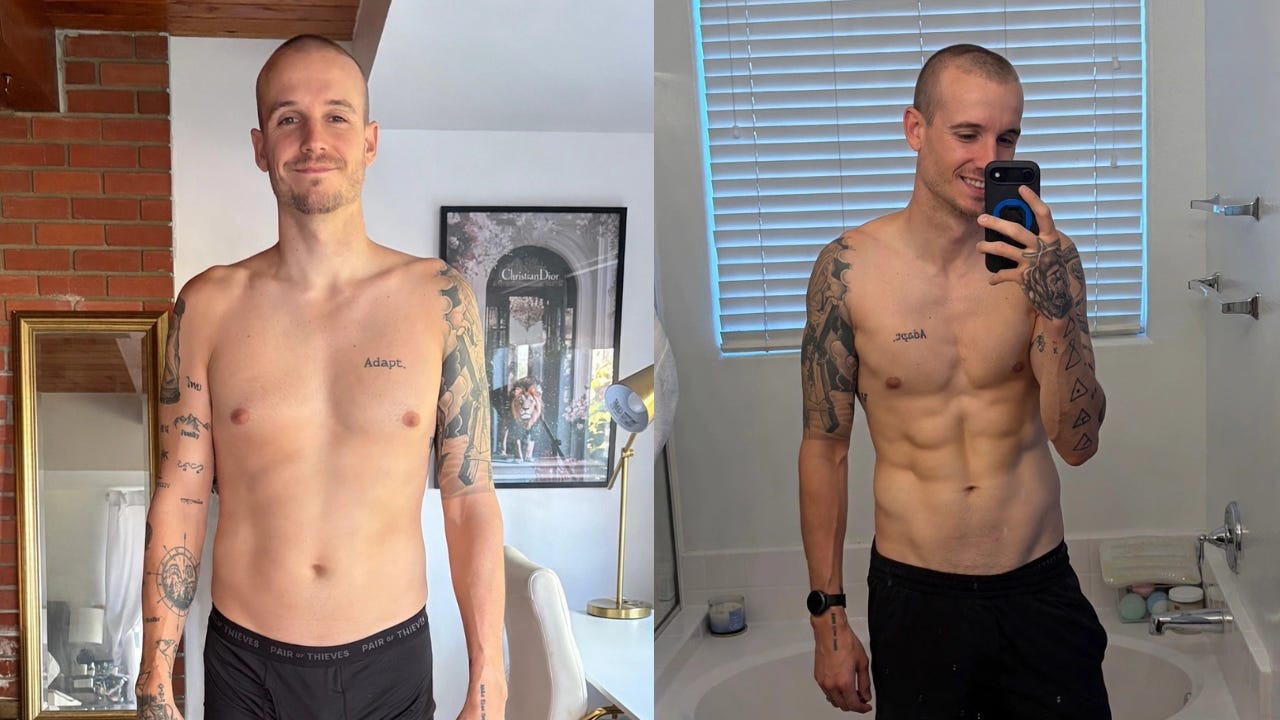
I have been fortunate to stay in shape for virtually my entire adult life. Because I maintained my physique, I never had a dramatic starting point worth documenting for our community. Coming back from Asia gave me that exact starting point. Shifting from 12% to 19% body fat at the same body weight showed what happens when nutrition isn’t dialed in, and catching it early allowed me to show our members how to reverse that trend safely and sustainably.
There was also a deeper personal reason for sharing this. In my younger years, I struggled with a deeply unhealthy relationship with food and exercise. There was a time in my life when my entire self-worth was tied to whether my abs were visible. That version of me would have been terrified to come home from a vacation soft, let alone document it publicly. I wanted to prove to myself how much I had grown, making a firm commitment to appreciate my body at 19% body fat before changing a single variable.
If you ever catch yourself disliking what you see in the mirror, please understand that you do not need to hate your body to earn the right to change it. I didn’t start this process out of self-criticism. I did it to demonstrate that a structured framework works even when life gets chaotic and unpredictable.
The strategy itself was built directly on the framework I teach inside our Mavy Wellness program. I set up three full-body strength sessions per week, calculated my daily baseline using the Mifflin-St Jeor equation, and established a conservative deficit of about 250 calories per day. My starting targets were 2,661 calories and 133 grams of protein daily, centered around whole-food, plant-based nutrition with built-in flexibility for real life.
During the first month, the focus was establishing a clean baseline without rushing to make adjustments too quickly. Most people make the mistake of tweaking their calories or workouts every few days when the scale fluctuates, but patience is what allows real data to emerge. By week two, my waist was tightening and my photos were shifting, even though the scale moved slowly. A lot of it was just getting rid of inflammation and puffiness.
By week three and four, life began throwing its usual curveballs. Ivy and I traveled to Las Vegas to house-hunt while an evacuation alert from a nearby wildfire threatened our home back in California. Between the travel heat, busy schedules, and restaurant meals, some days my calories dropped lower than intended. Shortly after returning, I sustained a hard impact to my head during a basketball game, right where I had suffered a concussion the previous year.
Despite the stress, I kept my nutrition on track, adjusted my workout schedule around my recovery, and focused on consistency over perfection. During a date night at our favorite vegan sushi restaurant in Agoura Hills, Ivy and I enjoyed 1,300 calories of vegan sushi, fitting it directly into my daily budget. That wasn’t a setback or a cheat meal; it was simply part of the design.
Overcoming Disordered Patterns and Navigating Change
Revisiting that date night reminded me of how far my relationship with food has evolved over the years. Long before I became a coach, my eating habits were deeply disordered. I can remember buying a box of donuts, eating most of them in a fit of guilt, throwing the rest in the trash, and eventually pulling one back out until I literally poured orange juice over the box to stop myself.
Learning to portion out a bowl of chips and salsa during week two of this transformation without anxiety or guilt was a massive personal milestone. If you have ever felt trapped by those types of food struggles, know that it isn’t a lack of willpower. It is a relationship with food that can be healed over time through structure, honesty, and dropping the concept of forbidden foods.
In June, we officially relocated to Henderson, Nevada, moving our entire home in 110-degree summer heat. Because my daily movement dropped and my new gym lacked a basketball court, I made my first structured adjustment: lowering my daily intake by 150 calories and replacing basketball with indoor cycling.
A week later, while performing lateral kettlebell squats, I strained my lower back. Rather than stopping completely, I asked myself what variables I could still manage. I adapted my strength work to chest-supported machines, reduced the weights, focused on tempo, and kept my nutrition locked in. By week seven, even with the back strain, my progress photos showed clear muscle definition and a tighter waist, proving that consistency with the basics matters far more than having a flawless week.
Navigating the Middle Phase and Managing Hunger
As we moved into July, business demands picked up significantly while I recorded over 100 hours of curriculum for our new Forever Fit program. Over those weeks, I traveled to Cleveland for a health conference where Ivy and I led workouts, and I managed to stay on track throughout the trip. Leaning on a clear framework while traveling allowed me to come home leaner than when I left.
When progress naturally slowed mid-July, I made another subtle adjustment, bringing my intake down to 2,300 calories and increasing cardio slightly. That was the point where genuine hunger set in. The internal voice that rationalizes taking off-plan days started creeping up, but I relied on high-volume plant foods, thin-sliced cucumbers, sparkling water, and making a daily protein ice cream in my Ninja Creami to stay full and satisfied.
On one occasion in the grocery store, I found myself putting a bag of jalapeño chips in my cart, only to put it back on the shelf before checking out. Every time you make that choice, you build the discipline muscle for the next time.
By August, I reached 183.3 pounds and 11% body fat. My clothes were sitting noticeably looser, and despite business launches, travel, and recovery, I hadn’t missed a single planned workout in fifteen consecutive weeks. As I neared the final month, I brought my calories down to 2,100 per day for the home stretch. I could have pushed further to get artificially shredded, but that wasn’t the goal. I was thrilled with how I looked and felt, and pushing deeper for the sake of a lower number would have defeated the purpose of building a sustainable lifestyle.
By week nineteen, following a successful client workshop in Las Vegas, I stepped back on the scale at 180 pounds and 10% body fat. I had reached my goal cleanly, safely, and with my lean muscle mass completely intact.
Immediately after hitting that target, I transitioned straight into Phase 2: Reverse Dieting. Instead of jumping right back to a higher calorie intake, I began systematically increasing my food by 50 to 100 calories at a time. This is the crucial step that so many people skip. Reverse dieting allows your body to adapt to higher food volume slowly, restoring your metabolic rate while maintaining your new physique. Fast on the way down, slow on the way up.
Looking back across these 19 weeks, the physical changes were rewarding, but the real power was in the daily execution. You set your sight on the peak so you know where you are headed, but then you take your eyes off the summit and focus on your feet. Left foot, right foot, left foot, right foot.
If you take anything from this story, let it be these core truths:
The scale is just one single data point among many, so look at the overall trend rather than daily fluctuations.
Never make impulsive adjustments based on one week of scale data; give your body two to three weeks to establish a baseline before making subtle changes.
Include foods you genuinely love within your daily budget, because a plan that lacks joy will never last long-term.
When you have an off meal or an off day, don’t waste energy feeling guilty or waiting for Monday. Win the very next meal and keep moving forward.
Separate your self-worth from what you see in the mirror, because your value as a person never changes based on a body fat percentage.
I documented these 19 weeks to demonstrate that these exact principles work in the real world, through busy schedules, travel, moves, injuries, and real life. This is the same foundation we use with our Mavy Wellness members every day.
I will have a short documentary of all the clips I filmed during this 19-week transformation coming at some point, so be sure to stay tuned for it on my YouTube channel.
Now, everything that I have accomplished is the exact same framework and work that our team of coaches brings our members through to be able to get incredible results at an age when most people think that they can’t transform anymore.
So if you are over 50 and ready to build a strong, vibrant physique that you can maintain for decades, Ivy and I would love to help you map out that journey.
You can book a free strategy call with Ivy directly at https://mavywellness.com/
Left foot, right foot. I will see you on the mountain.
Sincerely,
Maxime Sigouin
Author of Forever Fit - Your Body Recomposition System on Plants
Ps. My wife Ivy and I are kicking off a brand new live workshop series, and the first one is Tuesday, October 13 at 4pm Pacific: How to Lose Your Next 10 lbs. After 50 with plant based foods.
It’s live and there is no replay. Every two weeks we will cover a new topic, so bring your questions and get them answered in real time.
Save your seat here:
👉 Save your free seat here: https://mavywellness.com/live
There is no replay, so make sure you show up live.
So impressed with your results. Great job! I'm in week 22 of my Mavy wellness journey and down a little over 13 pounds and 3% body fat. Soon I'll be reverse dieting. 🎉 Never thought I'd be at a weight I was over 12 years ago with so much more fitness and a happy mind. Thanks for all your inspiration and tips along the way 🦋